Bill Ross gets the same phone call almost every day. An owner has read an article, or heard it from a friend, that anything over 380°F on the cylinder heads is bad for the engine. So he has been playing it safe. He leans a little further past peak to bring the temperatures down, and he has been flying around at 340 for a while now, and he would like to know if that is good.
It usually isn't. Ross explains how people end up there with what he calls the park bench conversation. Two pilots are sitting outside the FBO. One has read that 380 is the number to stay under. The other figures that if 380 is good, 350 must be better. By the time they get up, 300 is the target, and neither of them has looked at what the engine manufacturer actually says.
Ross is vice president of product support at Superior Air Parts, the company that makes the Millennium cylinder. Before that he worked in engineering and product support at another engine manufacturer. He learned to fly at 16, got his A&P, and spent most of his flying career on charter, freight and corporate work, nearly all of it behind piston engines. He still teaches as a flight instructor. When he gave this webinar for the Cessna Flyer and Piper Flyer associations, he was sitting in his own hangar in front of his family's Cessna 182. He pays for the avgas, and he hears about it from his wife every month.
His job means he takes the calls when an engine has a problem, and a lot of what he sees comes from owners who were gentle in the wrong places.
Your engine has already been tortured
Nobody bolts a case, a crank and some cylinders together, runs it on a test stand for 25 hours and calls it done. Every part goes through design work and development testing, and then the engine has to pass certification under FAR Part 33. Section 33.49 sets out the endurance test: 150 hours of running, and the engine has to be set up at its maximum limits while it does it. The Continental O-470 in Ross's 182 went through that with its cylinder heads held at 460°F.
The same process sets calibration, altitude performance and what Ross considers the most important item for anyone holding a mixture knob: detonation margin. The manufacturer has to show that the engine will not detonate when it is operated the way the book says, on the hottest day, with the mixture anywhere the book allows.
That is also why aircraft engines look so dated next to a car. Electronic leaning, variable timing, adjustable injection duration: all of it exists, and almost none of it is in general aviation, because every new feature has to go through the same certification process.
So when Ross keeps telling people to follow the manufacturer's recommendations, and he admits he sounds like a broken record about it, this is the reason. Those numbers come from an engine that was run to its limits on a test cell until it was proven safe. The number from the park bench came from somebody's friend.
The line in the POH that actually matters
If there is one idea Ross wants people to take away, it is the difference between two terms that sound alike.
Maximum continuous power is what the engine can make all day, every day, at full rich. Everything forward. Some engines have a five minute limit at takeoff power, but leaving that aside, this is the engine's full output.
Maximum recommended cruise is something else. It is the highest manifold pressure and RPM combination at which the manufacturer allows full leaning authority. At or below it, the engine was tested for durability and proven free of detonation with the mixture anywhere you like. Even with the heads at the 460°F Continental limit, or 500°F on a Lycoming, it could not be made to detonate by leaning.
At or below maximum recommended cruise, there is no red zone. You can do anything you want with the red knob and you cannot hurt the engine.
Finding it can take some digging. A few POHs state it outright, as a power percentage or a manifold pressure and RPM pair. Most don't. Open the cruise performance charts instead, the tables with altitude, manifold pressure, RPM, fuel flow and percent power. The top row of each table, where the chart ends, is maximum recommended cruise. In a 182 it is usually around 74% power, depending on altitude. If you fly an experimental, nobody has flight-tested that for you, and you have to work it out from the engine manufacturer's data.
Above that line, the advice in the manual is the limit. One owner quoted a Lycoming O-540 manual that says never to lean beyond 150°F rich of peak at max cruise power unless the POH shows otherwise. Ross read that as this same boundary, one the manual simply doesn't spell out in a sentence. If your turbocharged airplane's book says not to lean above 30.5 inches and you decide it would run better at 34, you have become a test pilot. That is how people get into trouble.
Below it, the choice of where to run is yours, and it really is a choice. Ross has no patience for what he calls the religion of lean of peak versus rich of peak. Some airframe and engine combinations will not run lean of peak at all. His carbureted 182 is one of them, and he runs it at best power. Some Continentals, the turbocharged 520s in a Cessna 402 for example, are most economical right at peak EGT. Continental has published guidance allowing operation at peak at or below 65% power. The leaning technique itself is covered in our leaning basics and the advanced leaning piece. Whichever you pick, Ross wants you to know where maximum recommended cruise is first, because that number is what makes the choice safe.
Detonation is a bang, not a burn
The thing all of those certification margins are protecting you from is detonation, and Ross thinks most pilots picture combustion wrongly to begin with.
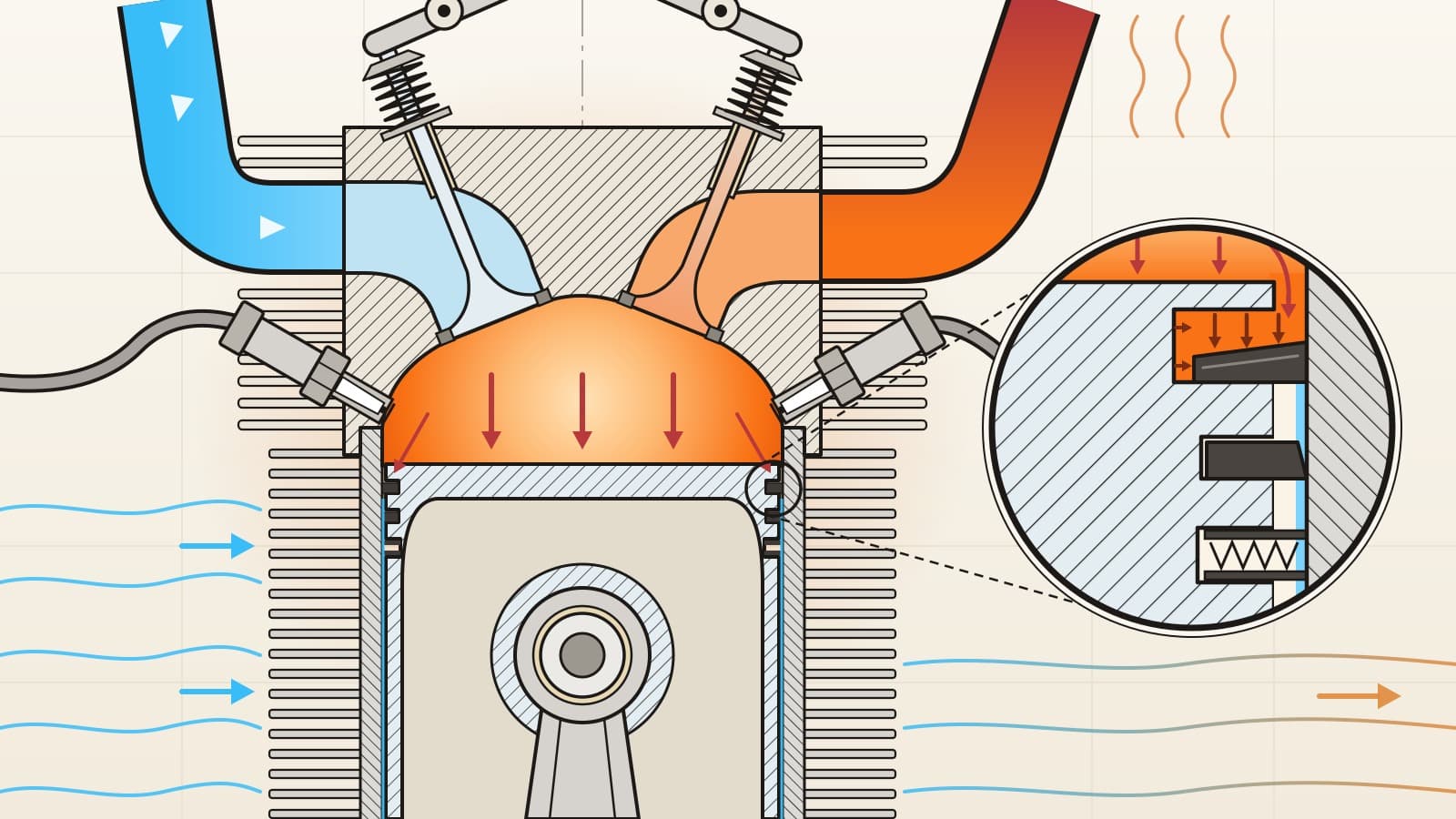
The usual mental image is that the spark fires and the mixture explodes and blows the piston down. That is not what normally happens. A healthy cylinder burns. The plugs light a flame front, it spreads across the chamber, the gas expands, and the piston gets a firm, steady shove.
Detonation is the version where it really does explode. The unburned mixture ahead of the flame ignites all at once. Pressure and temperature shoot up, and the heat has nowhere to go but into the cylinder head and the piston crown. In a car you would hear it as pinging on a hill. In an airplane, with engine noise, wind noise, propeller noise and a good noise-cancelling headset, you will never hear it.
What you can see is the signature. CHT goes up. EGT goes down. That looks backwards until you think about where the heat ends up. In a normal burn the flame front is still travelling when the exhaust valve opens, and the hot gas reaches the EGT probe. In detonation everything happens at once in a closed space, so the heat soaks into the head and very little of it gets to the probe.
Ross once took part in a test where an engine was deliberately detonated by cracking the insulator cores on its spark plugs. He watched a Continental's cylinder head temperature climb to 890°F. That is hot enough to melt a piston, and the pistons that come back from a detonation event show it: the edge of the crown eroded away, and almost no combustion deposits on top.
If an engine has detonated, changing the cylinder and going flying is not the fix. It needs to come apart.
Detonation can crack crankshafts, break connecting rods, and damage or extrude rod bearings. Ross treats it as a whole-engine event.
You won't get there by leaning at or below maximum recommended cruise, assuming the fuel is good and the timing is right. That last condition is where his favourite war story comes from. A customer called in with a detonated piston, the kind with the burned-away edge, and wanted it covered under warranty. They had already put a new cylinder on and were about to fly. Ross stopped them and went to the airplane. A mechanic had recently replaced the vacuum pump, and in doing it the gear on the magneto drive had been moved. The right magneto was firing at 58 degrees before top center instead of 22. With that much advance the pressure and temperature in the cylinder rose until the mixture was lighting itself off, like a diesel. There was never anything wrong with the piston.
Too cool is a failure mode too
Now back to the owner flying at 340. Ross goes through what happens on the mixture curve when someone leans well past the manufacturer's lean-of-peak recommendation just to get the heads cooler.
Say the book calls for 50°F lean of peak and the CHTs are sitting at 390. Lean further and the CHTs drop fast, which is the whole point. Everything else is getting worse while they do.
Ross puts the myth on a slide, "High CHT and pressure will damage my engine!", and then lists what actually goes wrong when you act on it. Efficiency goes first: past best economy the fuel-per-horsepower curve turns almost straight up, so you are giving away power without saving fuel. Power drops off the more you twist the red knob. Oil temperature sags, and cool oil leads to corrosion. And some pilots push it until the engine runs rough, which Ross has seen on flights with other pilots and which is hard on rings and pistons.
The oil temperature is the one he talks about most. Every oil company and every engine manufacturer he knows of wants about 180°F, sustained, in cruise. That is what cooks the water and the acids out of the oil. Below it they stay in, and they eat the engine from the inside. What the oil does the rest of the time is in our oil article.
If your engine is not running 180°F oil in cruise, you could be running it too cool, at too low a power, or leaning it too far past peak.
He says over the last ten or twenty years, as avgas has gotten more expensive and people have started babying their engines to save fuel, he has seen more corrosion and spalling at the cam and lifter interface than ever before. He thinks a lot of it comes from oil that never got hot enough.
Don't try to fix this by changing oil grade, either. Asked whether a different viscosity would help raise the oil temperature, Ross said to use the grade the engine manual specifies for your outside air temperature and get to 180°F by how you fly.
The ring needs the pressure
The second problem is less obvious, and it is about the piston rings.
The top compression ring on an aircraft piston has a semi-keystone cross-section, a slight wedge. It does not seal by spring tension alone. Combustion pressure gets into the groove behind it and pushes it down onto the land and out against the cylinder wall. Good combustion pressure means a well-seated ring.
Lean too aggressively and combustion pressure falls. The ring can lift off the land, and combustion byproducts get around behind it, down past the oil control rings and into the crankcase. That means higher oil consumption, faster wear, and oil loaded with combustion byproducts. Plenty of pilots assume that running well lean of peak keeps the engine "unloaded" and gentle. In Ross's view, overdo it and you get the opposite.
Combustion pressure is not a four-letter word. It is good for the engine, and it is good for the rings.
Flight schools with burned valves
The same logic runs all the way to valves. Ross has worked with flight schools that kept burning exhaust valves, with chronic lead fouling and carbon deposits to go with them. When he tells them they need to lean more, they look at him like he has three heads. They think the engines are already too hot.
They aren't. They are running too rich and too cool, and the deposits build up on the valves until a valve can't close fully. Then it gets torched on every combustion stroke. For those engines the answer is peak EGT, to get enough heat in to burn the deposits off. The same goes for aerial photography and other work flown at 50 or 55% power: lean to peak to get some heat into the engine and the oil.
That doesn't mean low-power cruise settings in the book are wrong. A 55% setting to stretch fuel in a hold, or for a training flight, does no harm for a while. What hurts is living there and never getting the engine properly hot.
What Ross actually does
He runs his 182 at maximum recommended cruise, not at 65% or anything below the top of the chart. He doesn't believe running at lower power buys the engine any extra life. At 65% and below, some airplanes start running too cool. That is part of why Continental put out its guidance about running at peak below 65%: it wanted people to get some heat back into their engines.
His CHTs sit at around 398 to 400°F. Oil temperature is about 185°F. The borescope shows good combustion deposits on the piston crowns. "It's right where I want to be," he said, "and doesn't bother me at all."
His rule of thumb for any engine is that it should run smooth in cruise with the heads below 400°F. If you want the full story on the upper limits, including why Continental and Lycoming land in different places, our CHT limits article covers it. What Ross adds is the floor under it. Being kind to an engine means keeping it in the middle of its range, not at the bottom.
One flight, start to finish
Most of the Q&A was about small habits, and they line up neatly along a single flight.
Take off at full power
Someone asked whether a long runway made a reduced-power takeoff reasonable. Ross said no. Even at Edwards Air Force Base, the runway is not the issue. At reduced power the airplane climbs slower, less air moves through the cowling, and you can lug and overheat the engine. Full rich at full power exists to protect the engine. If yours has a five minute limit, respect it, but don't take off at less than rated power thinking you are doing the engine a favour.
The prop pull after takeoff is optional
Ross brings the prop back to 2500 RPM at about 500 feet in the 182 and leaves the throttle wide open. It is a habit from charter flying in the 1980s, before noise-cancelling headsets, and it is for the passengers' ears, not for the engine. The engine is fine climbing at full throttle, full RPM and full rich.
A hot cylinder is usually an airflow problem
When one cylinder runs much hotter than the others, nine times out of ten it is a cooling air problem. First make sure the cylinder itself is healthy with a compression check and a borescope look for scuffing, scoring or heat damage. If it is, check the baffle seals and make sure they lie against the cowling, seal gaps in the baffling with good RTV, and confirm the inter-cylinder baffles are in place. Ross has been called out for "perfect" baffling and pulled bird nests out of it. For spreads between cylinders, he would start looking for a cause somewhere beyond 75 to 100°F, and not lose sleep over anything less.
Set power by manifold pressure and RPM
Several engine monitors show calculated percent power, but Ross sets power by manifold pressure and RPM from the book. Check the tachometer, too. He recently compared his 182's tach against a calibrated strobe and found it about 50 RPM off. If the tach is wrong, you may be at a different power than you think.
Easy on the prop lever
Watching someone snap the prop lever forward at high airspeed and overspeed the engine bothers him a lot. Rapid RPM changes are hard on the propeller and on the crankshaft's counterweights, the dampers that tame torsional vibration. Bring the prop forward once the power is back and it is off the governor, on base or final, and do it smoothly.
Leave a parked airplane alone
For a few weeks or even a few months of downtime, there is no need to pull the prop through. Starting the engine in the chocks for a few minutes is worse than doing nothing, because it never gets the oil anywhere near 180°F. If the airplane will sit for six months or more, preserve the engine per the manufacturer's preservation instructions. Superior, Lycoming and Continental all say much the same thing: an oil change, fog the cylinders with corrosion-preventive oil, and desiccant plugs in the spark plug holes. Done properly, the engine can then sit more or less indefinitely.
Oil, filters and the stuff in between
Cut open every filter
One owner changed oil at half the recommended interval but only changed the filter every other time. Ross said frequent oil changes are great, but he called the filter the best indicator of internal engine health. Every airplane he owns that has one gets a new filter at every oil change, and the old one gets cut open. Catching a problem early is better for safety and cheaper when it gets fixed.
Strange oil analysis numbers
A Millennium cylinder owner saw chromium and tin in his oil analysis around 110 hours since overhaul. Ross said elevated chromium during break-in is not unusual. Then he told a story about an RV with very high chromium, a clean borescope and good compression. It turned out the airplane next door had just been painted. Chromium in the overspray got into the engine through the intake or exhaust and into the oil. Once the paint shop was done, the numbers went back to normal.
Additives
Superior does not approve any oil additive, but Ross says that is because Superior has not tested them, not because it is against them. While he was at a previous manufacturer, he started a test of CamGuard on several engines. The first thing it showed was that the product did not hurt the engines, and the early results looked promising, though he left before the test finished. His advice is to look at the additive maker's engineering data and decide for yourself.
Mogas
Compression ratio matters. An O-470-U at 8.6:1 is no place for mogas unless you are operating under an STC. The 7:1 versions are much more forgiving. Ross's bigger worry is ethanol. Avgas travels in tankers that carry nothing else. A tanker hauling "ethanol-free" car gas may have carried ethanol blend the trip before. If you run mogas under an STC, test every batch for ethanol. Anti-knock quality also varies from pump to pump in a way avgas does not. He doesn't use it at all, not even in the family Stearman, whose 5.4:1 radial "will run on Alabama moonshine." It gets 100LL.
The short version
Find maximum recommended cruise in your POH. At or below it, the engine was certified to take whatever you do with the mixture, and there is no red zone. Above it, follow the book exactly.
Detonation shows up as CHT rising while EGT falls. You won't cause it by leaning within the book, but bad timing will, and once it has happened the engine needs to come apart.
Don't chase CHT down. Leaning far past the recommendation to get cooler heads costs power and efficiency, lets the rings lift, and leaves the oil too cool to boil off water and acid. Aim for 180°F oil in cruise and heads below 400°F, running smooth.
The engine was tested hot, on purpose, for 150 hours. It does not need you to keep it cold.
This article is based on the Cessna Flyer Association webinar Improve your aircraft engine operations and extend engine life by Bill Ross.