An RV owner emailed Mike Busch with a problem. His Lycoming IO-360 would not stay below 370°F on the cylinder heads no matter what he tried, and he wanted to know how to fix it.
Busch told him to stop trying. There is nothing wrong with a Lycoming IO-360 running 400 or even 410, and 370 was a target he had no reason to want and every reason to struggle with.
Where the number came from, neither of them knew. It is the kind of figure that gets absorbed from a forum post or a hangar conversation and then quietly turns into a rule. And there are a lot of pilots holding numbers like that, some too low, most far too high, almost none of them adjusted for the engine actually bolted to the airplane.
Whose engine is it
Start with the fact that Continentals and Lycomings do not want the same number.
Savvy Aviation's database of engine monitor data runs to something like three and a half million flights, which makes it the largest in the world, and one of the studies they ran on it compared real CHTs across the two manufacturers. Lycomings run about 20 degrees hotter than Continentals in service.
That is not a defect. Lycoming uses sodium filled exhaust valves, which are better at moving heat out of the valve and into the cylinder head, and the head is where your probe is. The heat was always there. The Lycoming just puts more of it somewhere you can see it. Lycoming cylinders are also built for it, with a more robust head to barrel junction and a wider friction band, which is a phrase worth remembering because we are coming back to it.
The factory redlines say the same thing: Lycoming typically 500°F, Continental 460°F.
Both of those numbers are absurd as operating targets. They are the temperature at which the manufacturer expects something to break, not a place to cruise. Busch's working limits are 400°F for Continentals and 420°F for Lycomings, and if you stay under whichever applies to you, both engine longevity and detonation margin take care of themselves.
He leaves himself more room than that in practice. He flies behind Continentals and aims for around 380. The equivalent aim on a Lycoming is around 400.
There is nothing magic about any of these numbers. They are ballpark targets for longevity, not emergency values. Nothing falls off the airplane at 401.
The gauge you should be reading instead
A factory CHT gauge has a green arc that runs all the way up to the factory redline, which means the instrument is telling you that 450°F is a perfectly nice place to be. It is not.
Busch re-marks the gauge in his head, and it is a habit worth stealing. On a Continental, a personal redline at 400 and a green arc topping out at 380. Above 380 he starts doing something about it. Above 400 he starts doing something aggressive. On a Lycoming, shift both up: personal redline 420, green arc to 400.
Nobody is suggesting you get out the paint. But if you have a digital engine monitor, set the alarm, because that is the same idea in a form that works. Busch has his JPI set to shout at him whenever any cylinder passes 400. It does go off from time to time, and when it does he fixes it immediately. We do not spend much of a flight scanning gauges, and an alarm does not need us to be looking.
There are three reasons to move those numbers. In unusually cold air, well below standard temperature, knock about 20 degrees off, because the same internal pressure will show a lower head temperature when the cooling air is that cold. If you fly something with a genuinely good cowling, a Cirrus or a Columbia or a Diamond, you can afford to be stricter than the numbers above, which are pitched at ordinary legacy cooling systems. And during break-in you should go the other way, because freshly honed cylinders run hot and need power to seat the rings: up to about 420 on a Continental, 440 on a Lycoming, until it is done.
The floor
Here is the part that gets left out of every hangar conversation about CHT.
You can run these engines too cool, and 100LL is the reason.
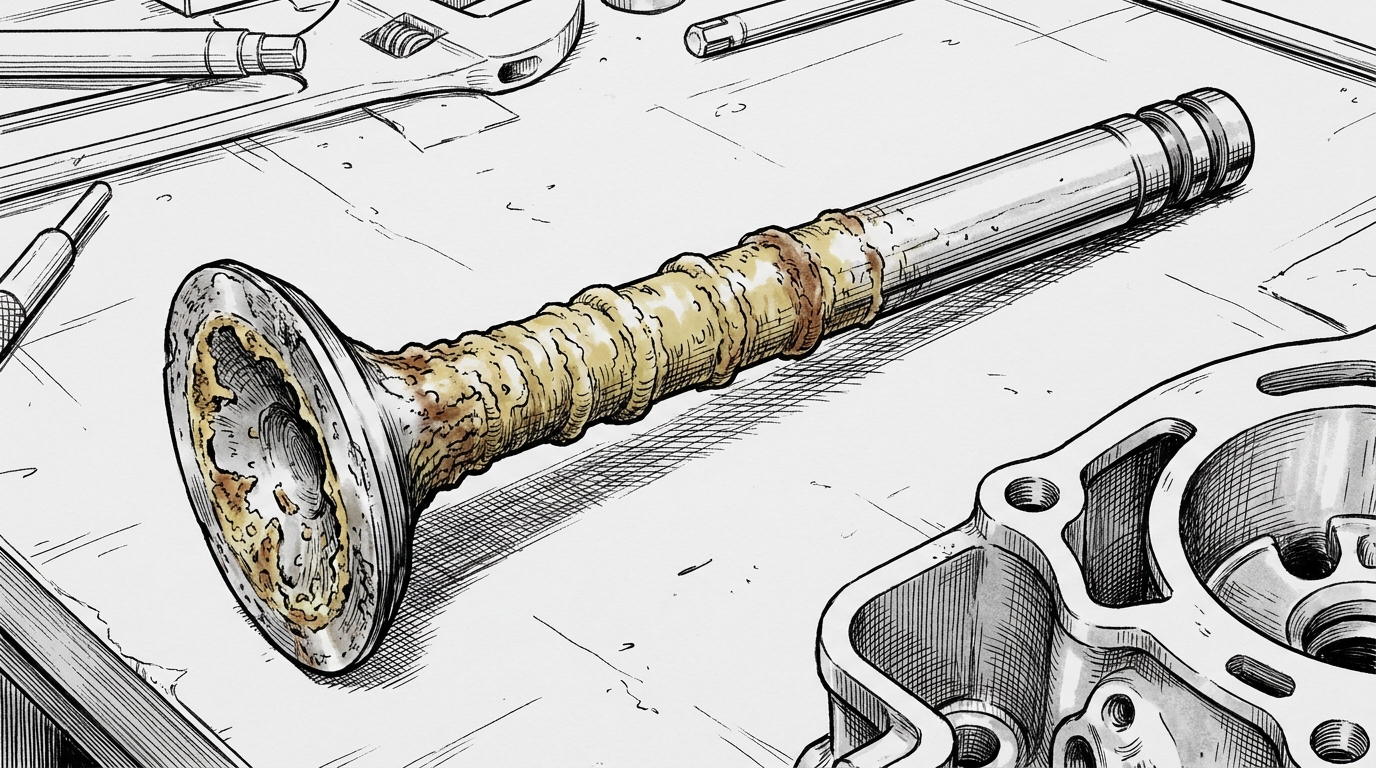
Avgas gets its octane from tetraethyl lead, and blended in with it is a scavenging agent called ethylene dibromide whose job is to grab the lead after combustion and turn it into something that leaves as a gas. That reaction needs heat. Run the combustion temperatures low enough and the scavenger stops doing its job properly, and instead of going out the exhaust the lead condenses as solid deposits on whatever is handy: spark plugs, valve stems, guides.
Lycomings suffer for it more than Continentals, and it is the sodium filled exhaust valves again, which are more vulnerable to building up lead bromide on the stems. Deposits on the stem stop the valve sliding freely in the guide, and a valve that does not move freely is the beginning of a stuck valve, which is the beginning of a considerably worse day.
So the green arc has a bottom as well as a top. Busch puts it at about 350°F for a Lycoming and about 330°F for a Continental, with a yellow arc below.
Which finally explains the RV owner. Chasing 370 on a Lycoming was not merely difficult, it was aiming below the sweet spot at the wrong end of the range.
The one thing that makes this concern disappear entirely is getting the lead out of the fuel. If your engine is eligible for mogas or for one of the unleaded avgas approvals, the floor stops mattering, because there is no lead to scavenge. Busch is unambiguous that the sooner the whole fleet gets there the better.
What you are actually protecting
We watch CHT because it is the only proxy we have for peak pressure inside the cylinder, which is the thing that actually breaks parts. On a test stand you can measure that pressure directly, using instrumented spark plugs with pressure sensors built into them, and watch the pressure trace in real time. Those sensors are expensive, they do not last long, and they will never be certified for an airplane. So we watch the head temperature instead and accept that it is an imperfect stand-in.
But there is a second, more literal thing that high CHT damages, and it is worth understanding because it explains why the redlines exist where they do.
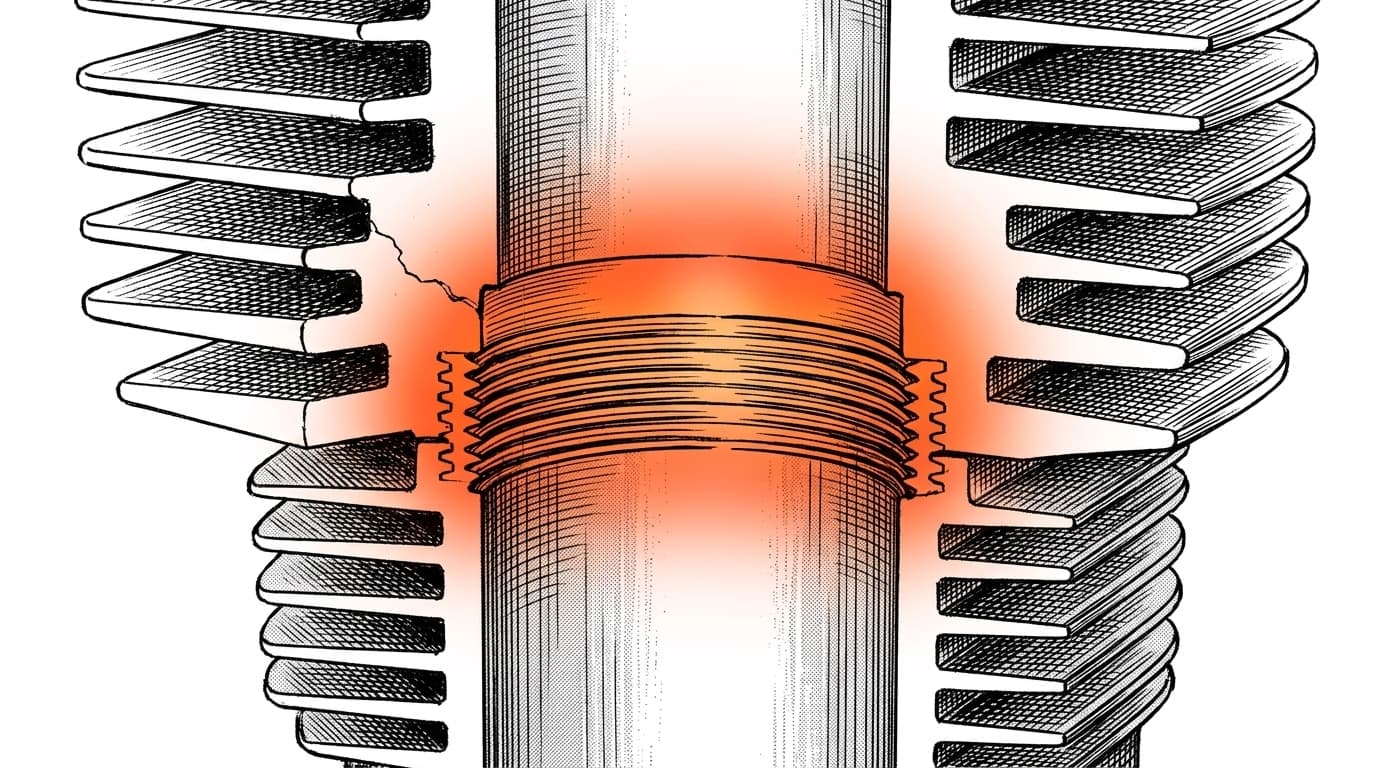
An aircraft cylinder is a steel barrel and an aluminium head, and joining those two is harder than it looks. The barrel has male threads, the head has female threads, and they screw together. There is also a smooth unthreaded section called the friction band. At the factory the barrel goes into a refrigerator and the head goes into an oven, the two are screwed together while they are at opposite temperatures, and as they equalise you get an interference fit.
The strength of that joint is supposed to live entirely in the friction band. It must not live in the threads, because every thread is a stress riser, and threads carrying combustion loads would fatigue and fail in short order. The threads are there to assemble the thing, not to hold it together.
Now heat the head. Aluminium expands more than steel, the interference fit slackens, and the grip of the friction band weakens. Get it hot enough and the friction band begins to slip, and when it does, the load it was carrying goes into the threads.
A head to barrel separation is almost always a fatigue fracture that starts at the first thread.
That is what the factory redline is actually about. It is not a temperature at which the aluminium melts. It is roughly where the joint stops being a joint.
There is a second effect running alongside it, which is simply that aluminium alloy loses strength as it heats, and loses it quickly above 400°F. That is why cylinder heads crack, and cracked heads are one of the ordinary reasons cylinders get retired.
The Cirrus that went six degrees over
A Savvy client was flying a Cirrus over Florida. Cirruses are exceptionally well instrumented aircraft, and this one recorded everything that happened.
One cylinder began running hotter than the others and kept going. The engine monitor data shows it climbing slowly and steadily over ten or fifteen minutes. Past 380. Past 400. Past 420. Past 440. Up to the 460°F Continental redline, and still climbing.
At 466 the head separated from the barrel.
He got the airplane down safely on five cylinders, shaking hard. He had never noticed. There was no alarm set, and he apparently was not looking at the engine page.
Two things stay with Busch about that flight. The first is how much time the pilot had. This was not a pre-ignition event that destroys a cylinder in ninety seconds. It unfolded over a quarter of an hour, and enriching the mixture at any point would almost certainly have ended it.
The second is how little margin there was above the redline. Six degrees. Whatever you assume about the safety factor built into a factory number, that flight suggests it is thinner than you would like.
Which is why Savvy's standing recommendation is that any documented excursion above the factory redline means replacing the cylinder. Not inspecting it, replacing it. You cannot look at a head to barrel junction and know whether the friction band let go a little, and you cannot look at an aluminium head and know whether its heat treat survived.
When every cylinder runs hot
If one cylinder is hot, the usual suspects are its mixture or its cooling air, and there is a straightforward test flight that separates them: run rich of peak and note the temperatures, then run lean of peak and note them again. A cylinder that is running lean because of a partially blocked injector or an induction leak will be the hottest of the set rich of peak and the coolest of the set lean of peak. That change in ranking is the giveaway. A cylinder that is hot both ways is not getting enough air, and the culprit is very often the inter-cylinder baffles, which are awkward to see and easy to misinstall.
But if all the cylinders are hot, look at ignition timing, and look at it first if the airplane has just come out of an annual.
The tell is that the CHTs are up and the EGTs are down at the same time. That combination means the timing is advanced, the charge is being lit too early, and peak pressure is arriving while the piston is still on its way up. It is very hard on the engine.
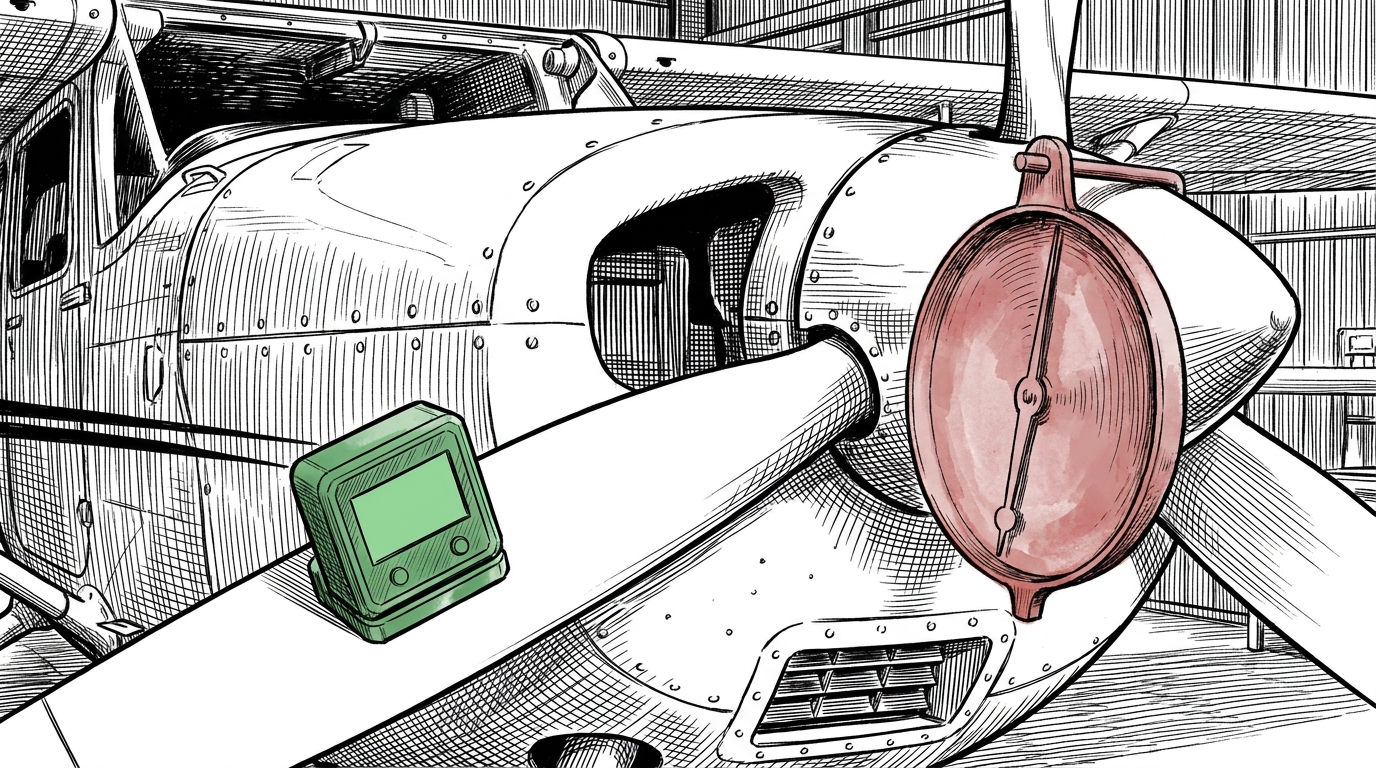
The tolerance on ignition timing is plus zero, minus one degree from what the data plate says. That is tight, and it is tighter than the traditional tool can manage. Plenty of shops still use the old pendulum timing indicator, the "flower pot", which has parallax problems, a pivot that goes sticky, and a scale you cannot read to a degree. A digital inclinometer costs about twenty dollars at a hardware store and reads to a tenth of a degree. Aircraft Spruce sells a proper timing kit built around one, with a prop holder and a top dead center finder, for about thirty.
The five degrees Lycoming gave back
Most Lycomings are timed at 25 degrees before top dead center: the 320s, the 360s, the IO-390, the 540s, the IO-720. That is an aggressive setting. Continentals are typically 22, and 20 if turbocharged.
In 1976, after a run of warranty claims on IO-360 cylinders that were running too hot, Lycoming issued Service Instruction 1325A, which authorised retiming most of the IO-360 A, C and D families, and their aerobatic versions, from 25 degrees all the way back to 20. Five degrees is an enormous change in ignition timing, and it did what it was meant to do.
It was a service instruction, though, never an AD. Lycoming started shipping new engines at 20, and the existing fleet did whatever each owner and shop decided. Which is why, decades later, the Lycoming CHT distribution in Savvy's database has two humps in it where the Continental distribution is a plain bell curve. Those two humps are the engines still timed at 25 running hot, and the engines retimed to 20 running cool, sitting in the same dataset.
If you fly an eligible IO-360 and you are fighting high CHTs, complying with SI 1325A will make a large and immediate difference. Note that full compliance is not just the timing: there is an impulse coupling with a different lag, or an adjustment on a shower of sparks system, to put the starting spark back where it belongs just after top dead center, and the instruction excludes the dual mag engines.
If you fly a Lycoming powered experimental, you can time the engine wherever you like, and dropping to 22 or 23 is worth experimenting with if you are running hotter than you want. The power you give up is small enough that Lycoming was willing to certify a five degree change without touching any of the engine's published specifications.
And if you fly a certified airplane that is not eligible, you cannot experiment. What you can do is make sure the shop sets the timing at the bottom of the tolerance band, nearer 24 than 25, and never, ever above the data plate figure.
Where your probe is
All of these numbers assume the CHT probe is where the manufacturer intended it, in the threaded boss machined into the bottom of the cylinder head.
Plenty of installations measure somewhere else. A spark plug gasket probe under the bottom plug can read as much as 40 degrees hotter than the proper location. Under the top plug it reads cooler. Neither is wrong exactly, but every target in this article shifts if that is what you have, and 40 degrees is the whole width of the sweet spot.
Some engines leave you no choice. The Continental O-200 and O-300 cylinders have no threaded boss, so a gasket probe is all there is. Just know which one you are reading.
While we are on things designed to confuse: Lycoming numbers its cylinders front to back, Continental numbers them back to front. On a Continental, number one is at the rear.
Shock cooling, mostly
We used to be quite frightened of shock cooling, and then engine monitors arrived and let us look.
Lycoming's guidance is not to let cylinder head temperature fall more than 60°F per minute. Busch has the alarm in his 310 set at 30, deliberately twice as conservative as the recommendation, and it hardly ever fires. Triggering it takes a genuine slam dunk: nose down hard and the throttle pulled well back at the same time.
The old ritual of reducing power an inch every two minutes on descent turns out to have been unnecessary. He now pulls five inches, lets things settle, pulls another five, and arrives at approach power without the alarm saying anything. There are probably operations where it genuinely matters, aerobatics and glider towing among them. Ordinary flying is not one of them.
The short version
The number you should be flying to depends on whose engine you have. Under 400 for a Continental, under 420 for a Lycoming, and the 20 degree difference is real, not a rounding error. The factory redlines at 460 and 500 are the temperature at which a cylinder head lets go of its barrel, and a Cirrus over Florida demonstrated that there is about six degrees in it.
Set the alarm. Nobody watches the gauges, and this failure takes fifteen quiet minutes.
And do not chase the number downward. Below roughly 350 on a Lycoming or 330 on a Continental, the lead in the fuel stops leaving through the exhaust and starts collecting on your valve stems instead.
Two things make a piston aircraft engine last. Fly it regularly, and keep the cylinder head temperature in the middle of the range. Not at the bottom of it.
This article is based on the Savvy Aviation webinar How Hot Is Too Hot? by Mike Busch.