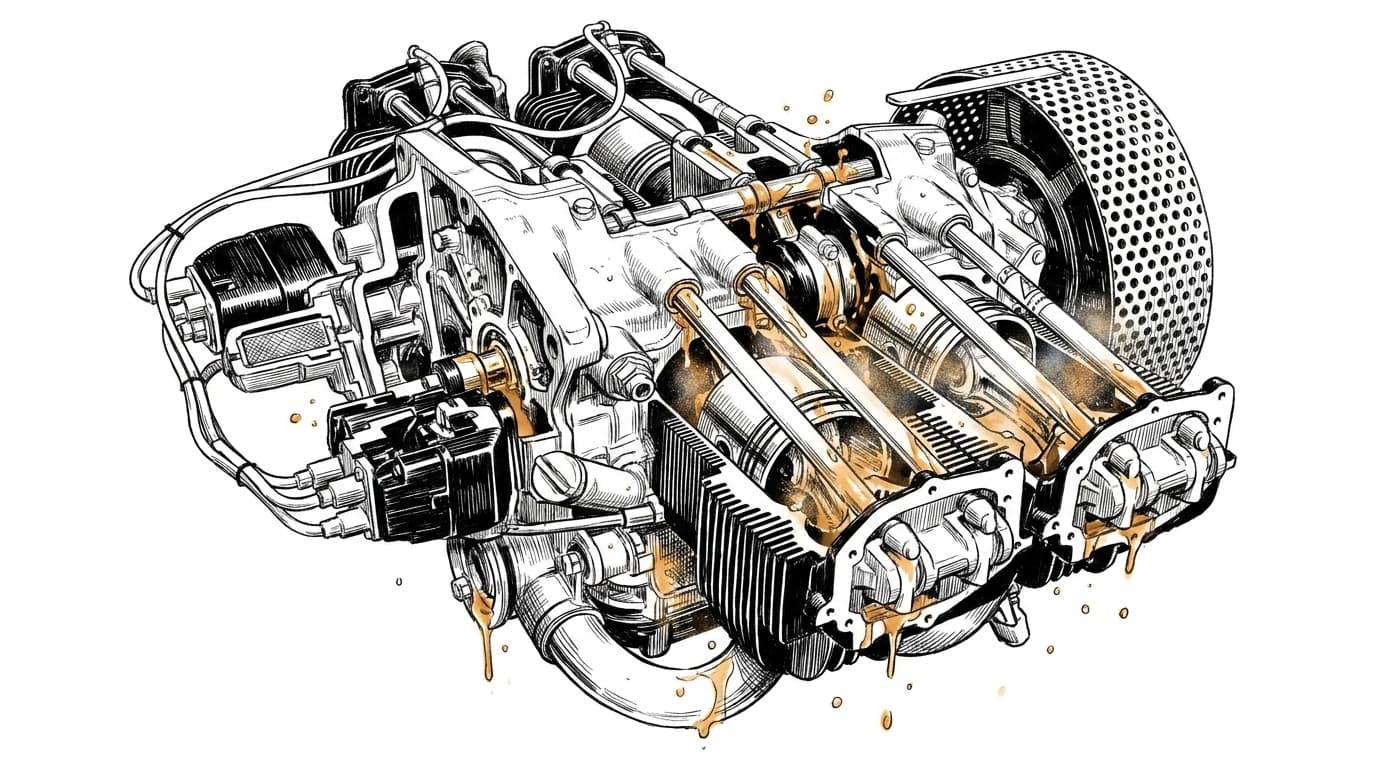
Mike Busch has been an aircraft owner for something over four decades. The Cessna Turbo 310 he flies and maintains himself has both engines past 200% of TBO, and eight of its twelve cylinders are the originals that went on the airplane in 1979, now carrying about 4,700 hours. Ask him what did that and oil comes up early in the answer.
Then he says something that seems to belong to a different conversation: in a piston aircraft engine, lubrication may not even be the most important thing the oil does.
Ask a pilot what engine oil is for and you get one answer, which is that it keeps metal from touching metal. True, and it is one job out of six. It might also be the one our engines make easiest.
The five jobs nobody mentions
Start with cooling. We call these engines air-cooled, but air only reaches the parts with fins hanging out in the slipstream, which mostly means cylinder heads. A piston gets none. It is aluminum, it sits directly under the fire, and the only reason it doesn't melt is that the engine throws copious amounts of oil against its underside. That heat goes into the oil, the oil goes through the cooler, and the cooler hands it to the air.
Then cleaning, which matters more here than in almost anything else with pistons in it. Aircraft engines are filthy beasts. They have far more blow-by than a car engine, they run on leaded fuel, and they push combustion byproducts and lead compounds into the crankcase faster than anything in your garage. All of that wants to settle out as sludge. The oil's job is to hold it in suspension so the filter catches what it can and you drain the rest.
Sealing gets no thought at all until something leaks. Oil is what makes the ring pack seal against the cylinder wall, and what keeps gases and liquids on the correct side of O-rings, gaskets, and the crankcase parting seams.
Actuating is the one most owners have never considered. If you have a constant speed prop, the hydraulic fluid changing its pitch is engine oil. If you have a turbocharger, the fluid working the wastegate is engine oil.
Last is corrosion protection, and this is the one that decides how long the engine lives. Airplanes spend most of their existence parked. Cam lobes, lifter faces and cylinder bores are bare ferrous metal sitting in a damp aluminum box, and the only thing between them and rust is a film of oil that has to survive weeks without being replenished.
The number one reason these engines fail to make TBO is corrosion. We almost never wear them out.
Hold onto that sentence. Every oil recommendation Busch makes falls out of it.
How oil keeps metal from touching metal
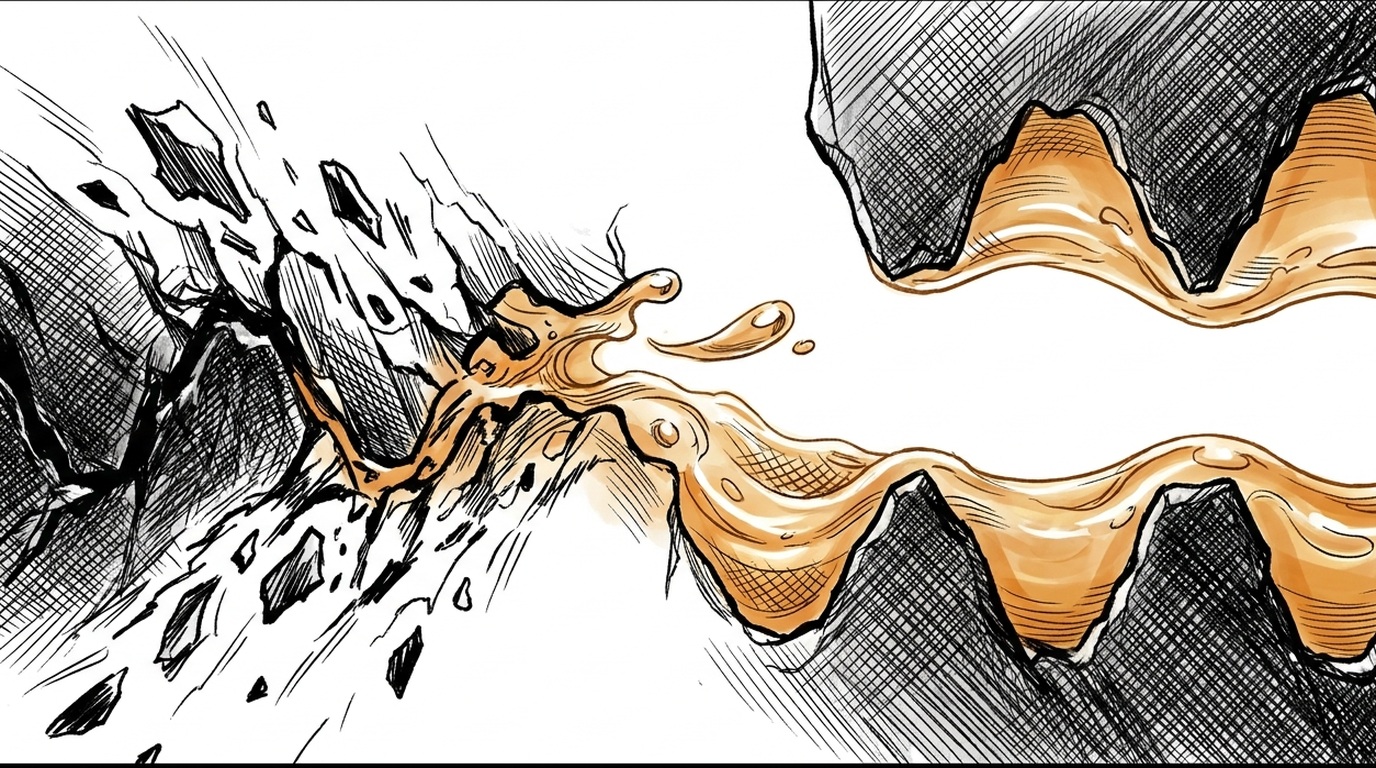
A surface that looks polished to the eye is a mountain range under an electron microscope. Press two metal surfaces together and the peaks touch and bond to each other, actual welds at molecular scale, forming and tearing continuously as the parts slide. That shearing and reforming is friction. The metal left behind when they tear is wear. Rub your palms together hard and the heat you feel is millions of micro welds being made and broken.
Oil beats them two ways.
Hydrodynamic lubrication keeps the surfaces physically apart. Put a fluid between two parts that are moving quickly past each other and the motion itself pressurizes the fluid, and that pressure carries the load. Busch's picture for it is a water skier: as long as the boat pulls hard enough, pressure under the skis holds the skier on the surface. Slow the boat down and the skier sinks.
Which is exactly what happens in your cylinders. A piston moving through the middle of its stroke has its rings riding on a pressurized film. At top dead center it stops, reverses, and for that moment there is no relative speed to make pressure with. Look inside a cylinder that has seen some hours and the wear you can see is right there at the ring reversal area, where hydrodynamic lubrication quit.
For those moments there is boundary lubrication, which is not a film holding parts apart but a chemistry that discourages micro welds from forming at all. It is never as good as hydrodynamic lubrication. It is what you have. Same trick with your palms, except instead of oil you dust them with talcum powder. Your hands still touch. They just slide.
Boundary lubrication is carrying the load at ring reversal, at the valve stem and guide (an exhaust valve runs so hot that liquid oil in there would simply coke), at the cam toe lifting a lifter against a valve spring, and, most of all, in the first seconds after a start when the parts are dry.
Worth knowing, too, is how the oil reaches any of this. Bearings are the only parts fed under pressure, through drilled galleries. The cylinder walls, the cam, the lifters get nothing pumped to them. They live on splash. Oil is extruded out of the main and rod bearings, and a crankshaft turning at cruise RPM flings it in every direction as a dense mist. Some of that mist hits the underside of the pistons, which is the cooling job. Some goes through holes in the piston to the oil control ring, which paints a fresh coat on the cylinder wall every stroke.
That geometry explains an old difference between the two engine makers. A Continental's camshaft sits low in the crankcase, below the crankshaft, so oil dripping off the crank lands on the cam and keeps landing on it for days after shutdown. A Lycoming's cam is up high, above the crankshaft, where gravity works against it. Oil leaves it first when the engine stops and reaches it last when the engine starts. Lycomings have a long and well earned reputation for cam and lifter trouble because of it. If you are overhauling one, the Ney nozzle STC puts small jets in the main gallery aimed at the camshaft so it gets oil the instant there is pressure. It does not solve the dry start. Nothing solves the dry start.
Why synthetic oil lost
Both mineral oil and the synthetic stock used in aviation oils are polymers, but they are shaped differently. Mineral oil molecules are branchy, with side chains hanging off them. Poly alpha olefin, the synthetic, is smooth.
Smooth is slipperier, and smooth survives. The branches on a mineral oil molecule snap off as the oil is worked between moving metal surfaces, so its viscosity degrades the longer it stays in service. Synthetic does not have that problem, which is why your car can go so far between oil changes.
But the branches are also hooks. Branchy mineral oil is much better at grabbing particulate matter and holding it in suspension, and it seals better around gaskets and O-rings. Synthetic is so slippery it finds its way past seals that mineral oil would not, and it cannot hang onto dirt.
That was a fatal problem here. The last fully synthetic aircraft engine oil on the market, Mobil AV-1, could not deal with the lead in avgas. Lead sludge dropped out of suspension and ruined engines. Mobil pulled it in the 1990s in a hail of lawsuits, and nobody has offered a full synthetic aviation oil since. What we have are semi synthetics: Aeroshell 15W-50 is roughly half PAO, Exxon Elite about a quarter, and both carry a generous helping of mineral oil precisely so the engine stays clean.
Neither of synthetic's advantages is available to us, and that is what settles the argument. You cannot cash in the extended drain interval, because you are not draining the oil when it wears out, you are draining it to get the filth out, and the filth arrives on schedule regardless of what the oil is made of. And the better lubricity is aimed at a problem we don't have. These engines turn 2,400 RPM with clearances a turbine designer would find comical. Their lubrication demands are modest.
The advantages of synthetic are compelling in turbines and in car engines. In a piston aircraft engine running leaded avgas, they are advantages you cannot spend.
If and when we are all running unleaded fuel, this gets reopened, and Busch expects a full synthetic to come back on the market when it does.
Thick oil clings, thin oil runs off
The naming is archaic and confusing and dates to before the Second World War. A monograde 100 grade is SAE 50. An 80 grade is SAE 40. It would be less confusing to say 50 weight and 40 weight, but here we are.
The W in Aeroshell W100 means ashless dispersant, the additive package that keeps the engine clean. Plain Aeroshell 100 and 80, without the W, have almost no additives and are sold as break-in oils, a tradition Busch has never seen any evidence for. The Plus versions add tricresyl phosphate as an antiscuff additive and a corrosion inhibitor.
A multigrade starts as a thin oil, something like an SAE 15, and gets viscosity index improvers blended in. These are man made polymers that curl up into a ball when cold and unroll as they warm, so they get thicker as the temperature rises. The base oil thins with heat, the VI improver thickens with heat, and the blender can shape the viscosity curve into more or less whatever they want. The thing to understand about VI improvers is that they are not lubricants. They are thickeners, cornstarch in the soup.
So an oil that behaves identically to another at operating temperature can behave nothing like it in the hangar. Aeroshell W100 and Aeroshell 15W-50 are both SAE 50 oils when hot. At room temperature the monograde is ketchup and the multigrade is tomato juice.
You can watch the consequence on your own dipstick. After shutdown, oil drains off the parts and back into the sump, and the level climbs. With a multigrade the level stabilizes within a couple of hours. With a monograde it can take days, because the film is gooey enough to stay where you want it. That film is the only corrosion protection a parked cam lobe gets.
Multigrade's advantage is real, and it is narrow: below freezing, a thin oil builds oil pressure faster on start. If your airplane never sees a sub freezing start, you are paying that corrosion penalty for nothing.
So Busch's advice for the airplanes his company manages: monograde most of the year, and where winter really does mean cold starts, switch to a multigrade for those months and go back afterward. Four months of multigrade, eight months of monograde is a common pattern. And when it has to be a multigrade, Phillips XC 20W-50, because it is the one multigrade on the market made entirely of mineral stock with no synthetic in it at all.
Aeroshell 15W-50, the most popular oil in the general aviation fleet, is the one he actively tells his clients not to use.
What actually goes in the sump
His own airplane gets Aeroshell W100 with a pint of CamGuard at every oil change.
CamGuard is an aftermarket additive he tested on his own engines for three years before recommending it to anyone. Its headline claim is corrosion inhibition, and he rates it noticeably better than the inhibitors blended into W100 Plus, Exxon Elite or 15W-50. His oil analysis showed a wear metal reduction of around 15% as well, which he describes as unspectacular, because there was not much wear there to remove.
If you would rather not pour anything extra in, buy an oil with the inhibitor already blended, meaning W100 Plus or Exxon Elite. If you run Phillips XC 20W-50, which has no antiscuff additive in it, add something. Lycoming's LW-16702 is the same tricresyl phosphate that Shell and Exxon blend into their premium oils, and it is a good antiscuff additive, but it does nothing for corrosion. CamGuard does both. If you are already paying for 15W-50 or Elite, adding CamGuard on top is a third dose of an additive package you have bought twice.
Three more, briefly. Never put anything containing Teflon or PTFE into an aircraft engine: NASA found the particles flocculate into clumps big enough to block small passages such as hydraulic lifters, and DuPont says plainly that it should never go into a motor oil. Avblend does no harm, but when Savvy ran it in piston twins with one engine treated and one not, under a rigorous oil analysis program, they could not identify the treated engine from the results. And Marvel Mystery Oil is no longer much of a mystery, since the MSDS lists the ingredients, which include pig fat, perfume and red food coloring. Underneath the cosmetics it is a solvent. It has never been approved and never hurt anything, and it genuinely does free up sticky lifters, which is the one reason to reach for it.
How much oil, and how often
Do not fill to the top of the dipstick. Certification requires a wet sump engine to run normally in every flight attitude at half its maximum capacity, and most will do considerably better than that. Fill it right up and a lot of engines will simply throw the top two quarts overboard. Busch runs about two thirds: five or six quarts in an eight quart sump, eight quarts in the twelve quart sumps on his 310.
Change the oil at 50 hours or four calendar months, whichever arrives first, if you have a spin-on filter. Make it 25 hours if all you have is a screen, because a screen leaves far more particulate in suspension. If you are on a screen, retrofit the filter. It pays for itself by doubling the interval, and it gives you somewhere useful to look for metal.
The hours are about filth. The four months are about acid. Oil carries acid neutralizers, but a finite quantity of them, and once they are used up the acid starts working on the camshaft and the crankshaft. This is also why you should change the oil before a long layup rather than after it. Coming home from a trip knowing the airplane will sit for two months is a reason to change the oil that evening, so it sits full of clean oil instead of dirty.
Oil temperature belongs in the same discussion. Busch wants to see 180 to 200°F, and at least 170°F in stable cruise. The reason is not obvious: on almost every aircraft engine the temperature probe sits at the coldest point in the circuit, usually right after the oil cooler, and the oil picks up roughly 40°F on its way through the engine. So 170 on the gauge means about 210 at the hottest point, which is what you want, because combustion produces a great deal of water, blow-by puts a fair amount of it into the oil, and the only way the engine purges it is by boiling it off out the breather. An engine whose oil never gets hot is an engine keeping its water and acid.
As for consumption, there is no normal. Big bore burns more than small bore, six cylinders more than four, Continentals more than Lycomings of the same displacement. Anywhere between a quart in four hours and a quart in twenty is fine. Under a quart in twenty and Busch starts worrying the top of the cylinder is not getting enough oil, and there is history behind that worry. The Continental powered Piper Malibu launched with almost no oil consumption at all and everybody was delighted until the engines reached about 500 hours and started eating cylinders. Continental reduced the tension on the oil control rings, accepted more oil consumption, and got the cylinder life back.
What deserves attention is not the number but a change in the number. An engine that has always used a quart in ten hours and suddenly uses a quart in five is telling you something, even though a quart in five is a perfectly respectable figure. It might be a filler cap gasket letting pressurized air into the crankcase and pushing oil out the breather, or a tired front crank seal, both of which can wait for the next convenient maintenance visit. It might also be a broken compression ring. You want to know which.
The same goes for how quickly the oil goes dark. Fresh oil is so clear it can be hard to read on the dipstick. If it turns dark and opaque within a few hours of a change, that is blow-by, and it is worth a compression test and a borescope to find out which cylinder is responsible.
One thing not to do about high oil consumption is bolt on an aftermarket air-oil separator. It treats a symptom you specifically want to be able to see, and it can hide a genuine internal problem. Worse, it is not really an air-oil separator at all. It is a liquid separator, and it cannot tell oil from the water and acid the engine was trying to expel, so it returns those to the sump. Some engines came from the factory with small ones and there is no choice about those. Adding one is a bad trade.
The filter and the lab
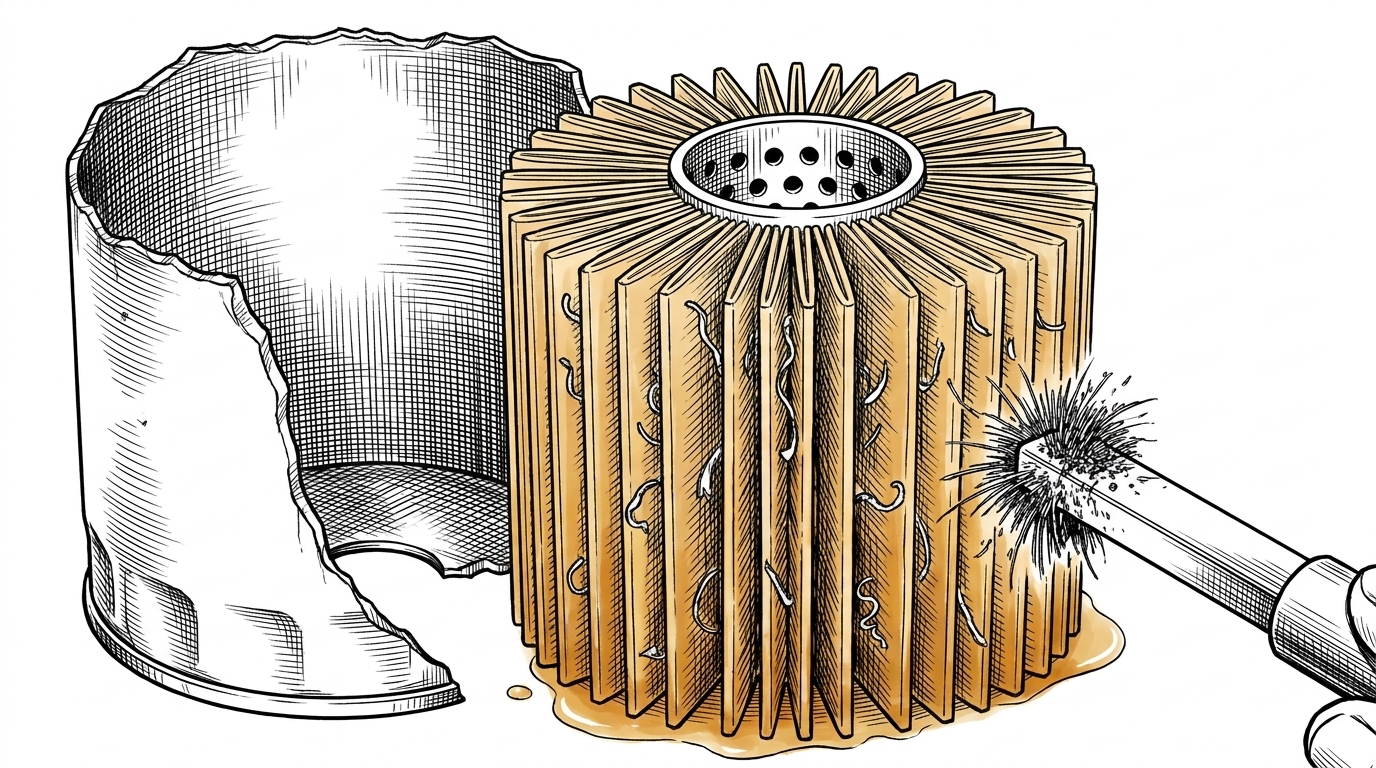
Cutting the filter open and looking for metal is the single most useful thing you can do to judge the health of an engine. Regulation requires it at the annual. Do it at every oil change.
A little metal is normal, especially on a low time engine or after cylinder work. Continental offers no guidance whatsoever on how much is too much; Lycoming has written service bulletins on it, so Busch uses Lycoming's numbers even on Continentals, on the grounds that they beat nothing. Below an eighth of a teaspoon, fly another 25 hours and cut the next one open. Between an eighth and a quarter, fly ten and look again. Above a quarter of a teaspoon, ground the airplane until you know where it came from.
A quarter teaspoon of metal is a colossal amount. If you found it in your filter you would levitate six inches off the floor.
First move when you do find some is to hold a magnet to it. Ferrous metal is the one to worry about. Non-ferrous is often something fairly benign like piston skirt scuffing. Shape tells you things too: metal in the form of whiskers almost always means a lifter is coming apart.
If there is a real quantity of it and no obvious source, send the filter media to a lab for scanning electron microscope analysis. It sounds like something you would need a grant for. It costs under a hundred dollars and comes back in about two days naming the quantity, shape and alloy of the metal, and the alloy names the part, because cams, cylinders, bearings and starter adapters are all made of different stuff. That is a lot cheaper than taking an engine apart to go looking.
Spectrographic oil analysis is the other half of the picture, and it is a complement rather than an alternative. Fast wear events throw off big particles that end up in the filter where you can see them. Slow wear on hard surfaces throws off particles too small to be filtered and far too small to see, and those stay in suspension in the oil. You need to know about both.
Where this earns its keep is in warning you years ahead. Exhaust valve guides are made of a high nickel alloy, so when they begin to wear abnormally the nickel level in your oil reports starts climbing long before the valve burns. One of Busch's engines had run around 16 parts per million of nickel for years, against a universal average of 14 for that engine type. It began to drift up, reached 35, and about a year after that he pulled a cylinder and had it overhauled. The analysis will not tell you which cylinder, so you borescope to find that. What it tells you is to start looking.
The $50 bill
Almost none of the wear in your engine happens while you are flying it. Steady state cruise is close to free. Valve guides wear a little, the ring reversal area wears a little, the cam and lifters wear a little, and that is about it. Piston engines that run continuously, the kind that sit in oil fields and never stop, last more or less forever.
The wear happens at start, in the first 15 or 20 seconds, before an oil film is re-established. The longer the airplane has sat, the drier the parts and the worse the damage. Cold makes it dramatically worse. Busch reckons a single cold start at 20°F does more physical damage to the engine than 500 hours of normal operation.
Starting an engine cold soaked below freezing is a crime. Below 20°F it is a felony.
His friend John Frank has a version of this that is easier to feel: every time you turn the key, picture taking a fifty dollar bill out of your wallet and throwing it out the window. On a twin, one out of each side.
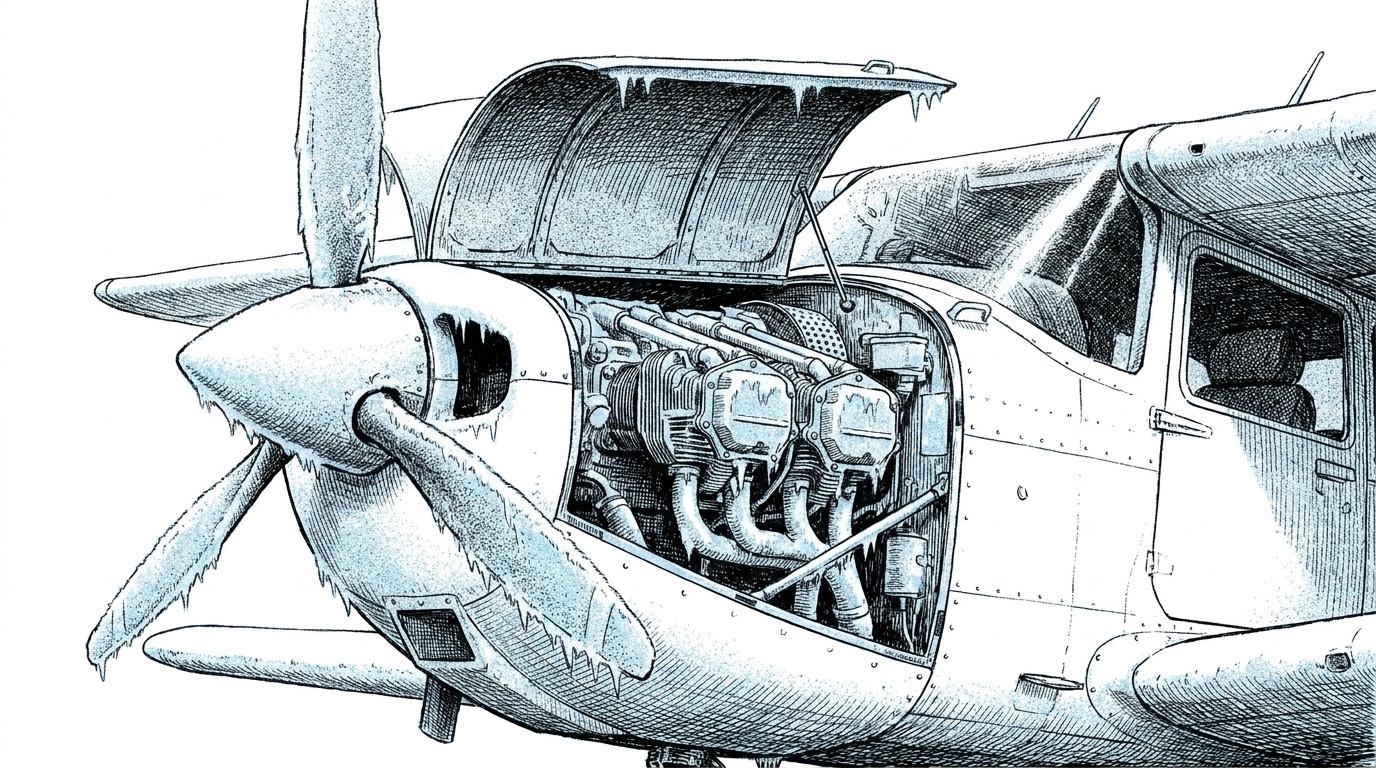
Which brings up the last thing worth doing. If the airplane is going to sit for more than about sixty days, pickle it. Both Lycoming and Continental publish nearly identical procedures. Change the oil and fill the sump with a preservative oil, either Phillips Anti-Rust or Aeroshell Fluid 2F, then fly it ten or fifteen minutes to distribute the stuff properly, cycling a constant speed prop several times to get it into the dome. After shutdown, pull the top spark plugs and screw in desiccant plugs, put a cloth bag of desiccant crystals in the exhaust and another in the intake, and tape over them. An engine preserved like that will sit a couple of years without corrosion problems. You are allowed to fly 25 hours on preservative oil afterwards, though Busch would rather you warmed it up, drained it and put real oil in before going anywhere.
The short version
Oil in a piston aircraft engine does six things, and the one everybody thinks of is the one it finds easiest. These engines turn slowly, with loose clearances, and they hardly wear at all in flight. What kills them is rust while parked and filth while running.
That points every decision the same way. Mineral oil over synthetic, because synthetic cannot hold lead in suspension and its real advantages are ones leaded avgas prevents you from using. Monograde over multigrade wherever the weather allows, because thick oil is still on the cam lobe next week. A corrosion inhibitor either blended in or poured in. Two thirds of a dipstick, not a full one. Fifty hours or four months, and cut the filter open every time.
Watch the filter for the fast failures and the oil analysis for the slow ones. Preheat before you start. Pickle it before you leave it.
This article is based on the Savvy Aviation webinar All About Oil by Mike Busch, itself drawn from a pair of columns he wrote for Sport Aviation.