Why most pilots lean their engines wrong (and what Embry-Riddle learned the hard way)
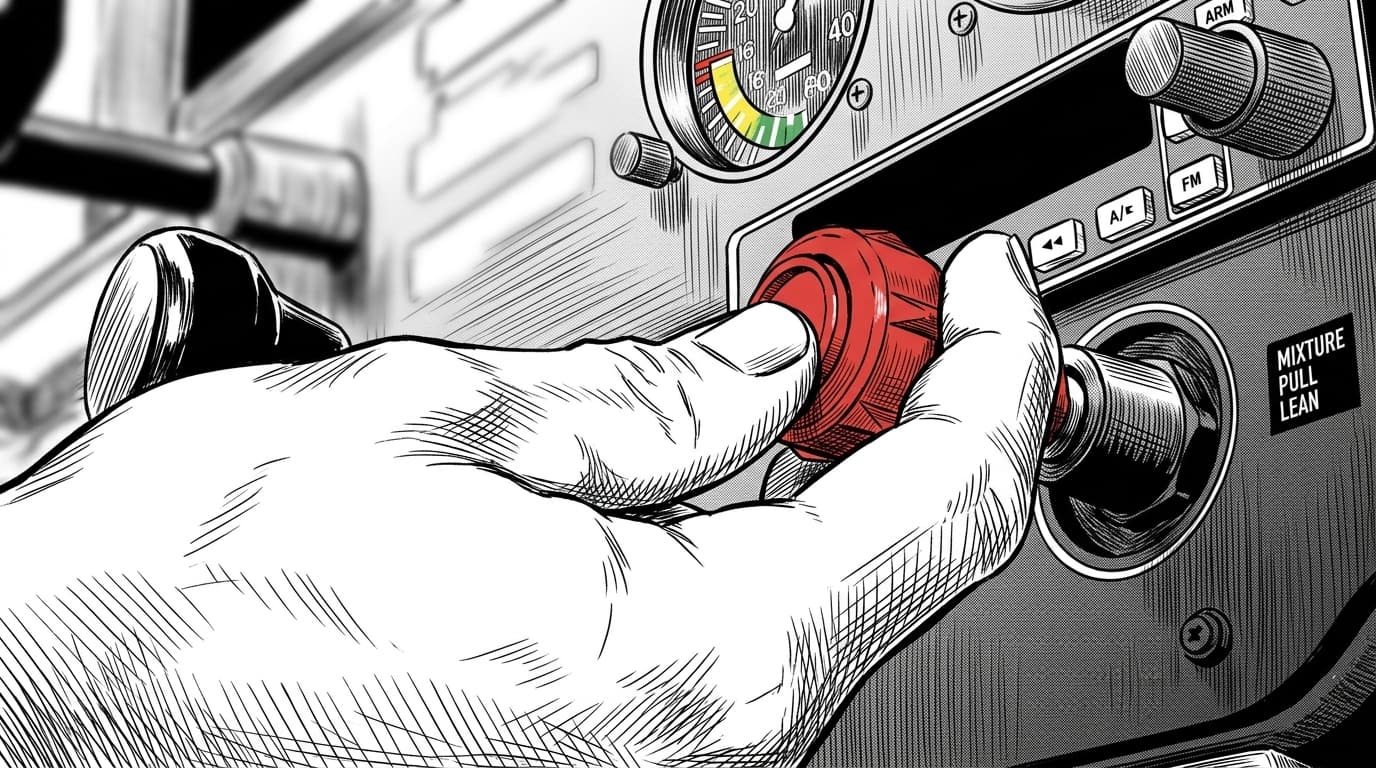
If you learned to fly in the last few decades, there's a good chance your flight instructor told you to leave the red knob alone. Maybe they said "fuel is cheaper than engines." Maybe they just never brought it up, figuring you had enough to worry about keeping the shiny side up.
Turns out that advice is backwards. Running your engine too rich doesn't protect it. It damages it.
Mike Busch, who runs Savvy Aviation and has been flying and instructing for over four decades, laid this out in a webinar that's worth every pilot's time.
The Embry-Riddle disaster
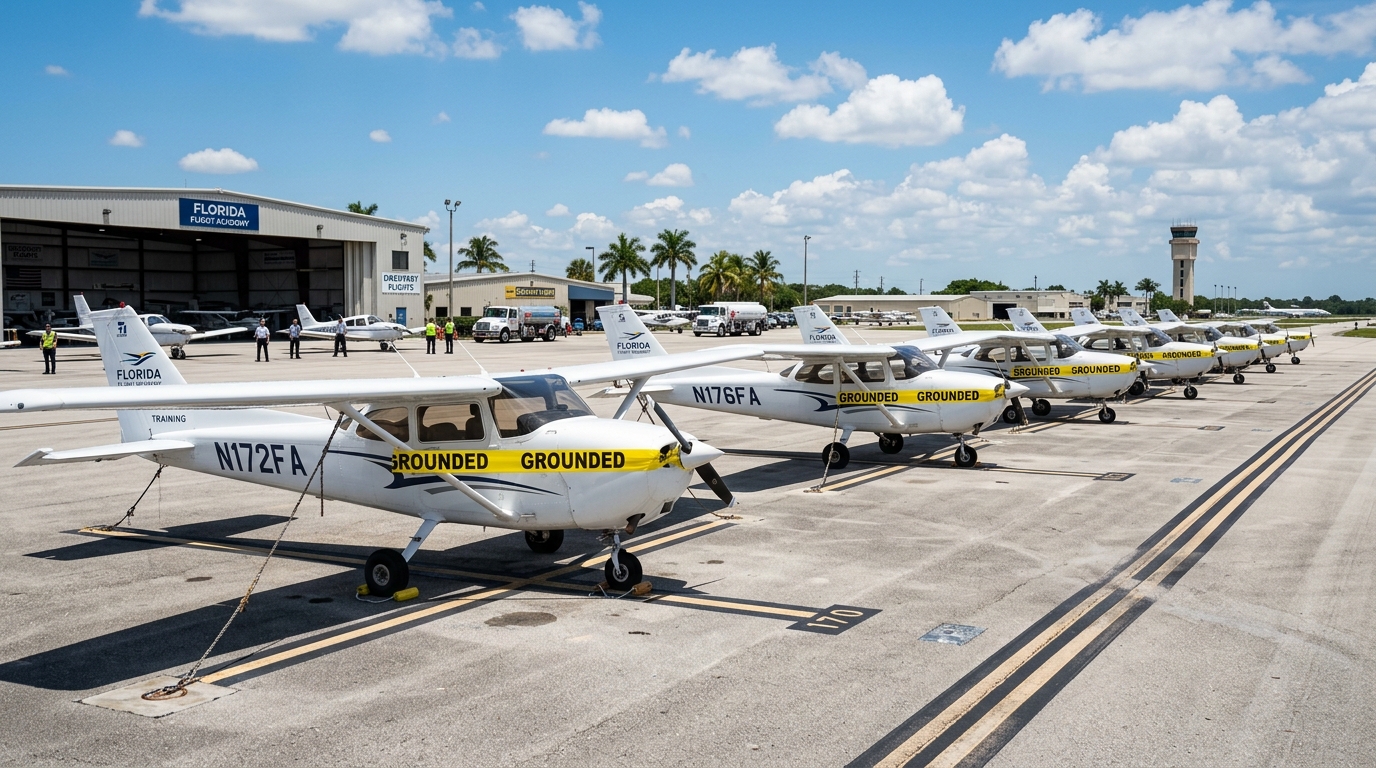
In the late 1990s, Embry-Riddle Aeronautical University in Daytona Beach was replacing its training fleet with brand new Cessna 172R aircraft powered by Lycoming IO-360-L2A engines. Beautiful airplanes, fresh off the line from the restarted Cessna factory in Independence, Kansas.
Then things went sideways.
The flight school started having engine problems across the fleet. Hesitations, rough running, fouled spark plugs. It got bad enough that Embry-Riddle grounded most of these new aircraft. A tiger team from Cessna and Lycoming flew down to Florida to figure out what was going on.
The diagnosis? The instructors and students were running the engines way too rich.
"Don't distract primary students with mixture management" - the old training tradition was destroying brand new engines. Students in Florida, training at sea level, never touched the mixture because they were taught not to lean below 5,000 feet. In Florida. Where nothing is above 5,000 feet.
The fix came in August 1999 as Lycoming Service Instruction 1497 (later amended to 1497A). Its guidance was a complete reversal of what instructors had been teaching:
- Don't over-prime during engine start
- Lean to maximum RPM for all ground operations, including run-up
- Lean during all climbs above 3,000 feet density altitude
- Lean during cruise at all altitudes, even low ones
Once Embry-Riddle started following these procedures, the engine problems disappeared.
The only two times you want full rich
Busch boils it down to something almost absurdly simple. Full rich mixture should only be used in two situations: cold engine start, and takeoff from an airport below 3,000 feet density altitude.
That's it. Every other time, the engine should be leaned. Full rich for a minute or two at most, then lean it out.
Why? Aircraft piston engines don't have a choke. Unlike your car or your lawn mower, there's no separate enrichment device for cold starting. Instead, the full rich position is set extremely rich to serve double duty: cold starting and providing detonation margin at 100% takeoff power. That mixture is completely wrong for anything else.
Running full rich during taxi and cruise is like trying to mow your lawn with the choke stuck on. The engine runs, but it's belching unburned fuel, fouling plugs, and building deposits.
A simple leaning checklist
For a basic airplane with a fixed pitch prop and standard instruments, no engine monitor needed:
Ground operations: lean to maximum RPM. That's best power mixture, and you can find it on any airplane by slowly pulling the mixture back until RPM peaks.
Takeoff below 3,000 feet density altitude: full rich.
Takeoff above 3,000 feet: lean to maximum RPM.
Climb above 3,000 feet: lean to maximum RPM.
Cruise at any altitude: lean until the engine starts to complain, then richen just enough to restore smooth operation. No more than that.
If you fly a simple trainer, that's the whole procedure. You're done.
The mixture envelope
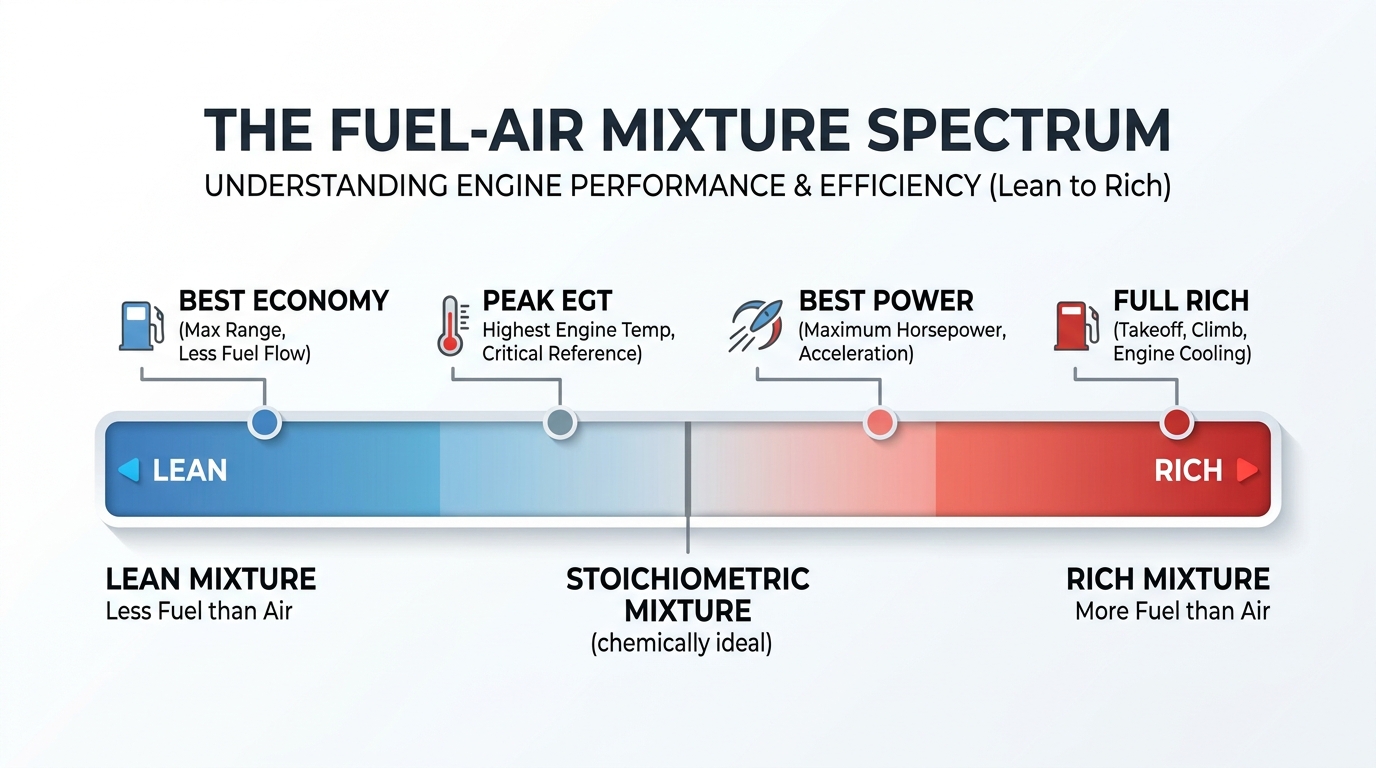
Gasoline can sustain combustion across a surprisingly wide range of fuel-to-air ratios, roughly 1:8 on the rich side to 1:18 on the lean side. Drop a match into a bucket of gasoline and the match goes out - too rich to burn. Pull your mixture control to cutoff and the engine quits - too lean. Everything in between will burn, but not equally well.
Three points on that spectrum matter for pilots:
Best power mixture, around 1:12.5, gives maximum horsepower. On a fixed pitch prop it's where you find maximum RPM. Typically about 75-100 degrees rich of peak EGT.
Peak EGT corresponds to stoichiometric mixture, around 1:15. Chemically perfect combustion. Useful mostly as a reference point.
Best economy, around 1:16, gives the most miles per gallon. About 30-70 degrees lean of peak EGT.
The math on why this matters: going from best power to peak EGT cuts fuel flow by about 20% and only costs 1.5% airspeed. Going further to best economy saves another 20% on fuel for about 5% less airspeed. With avgas running six or seven bucks a gallon, most pilots would happily give up a few knots to cut their fuel bill nearly in half compared to best power.
Forget EGT. Watch CHT.
This might be the single biggest misconception Busch addresses. Many pilots think high EGT means engine stress. It doesn't. EGT only measures how much energy you're wasting out the exhaust valve. In fact, EGT can actually go down as engine stress goes up, because when peak pressure occurs too early in the combustion cycle, more energy gets absorbed destructively before the exhaust valve ever opens.
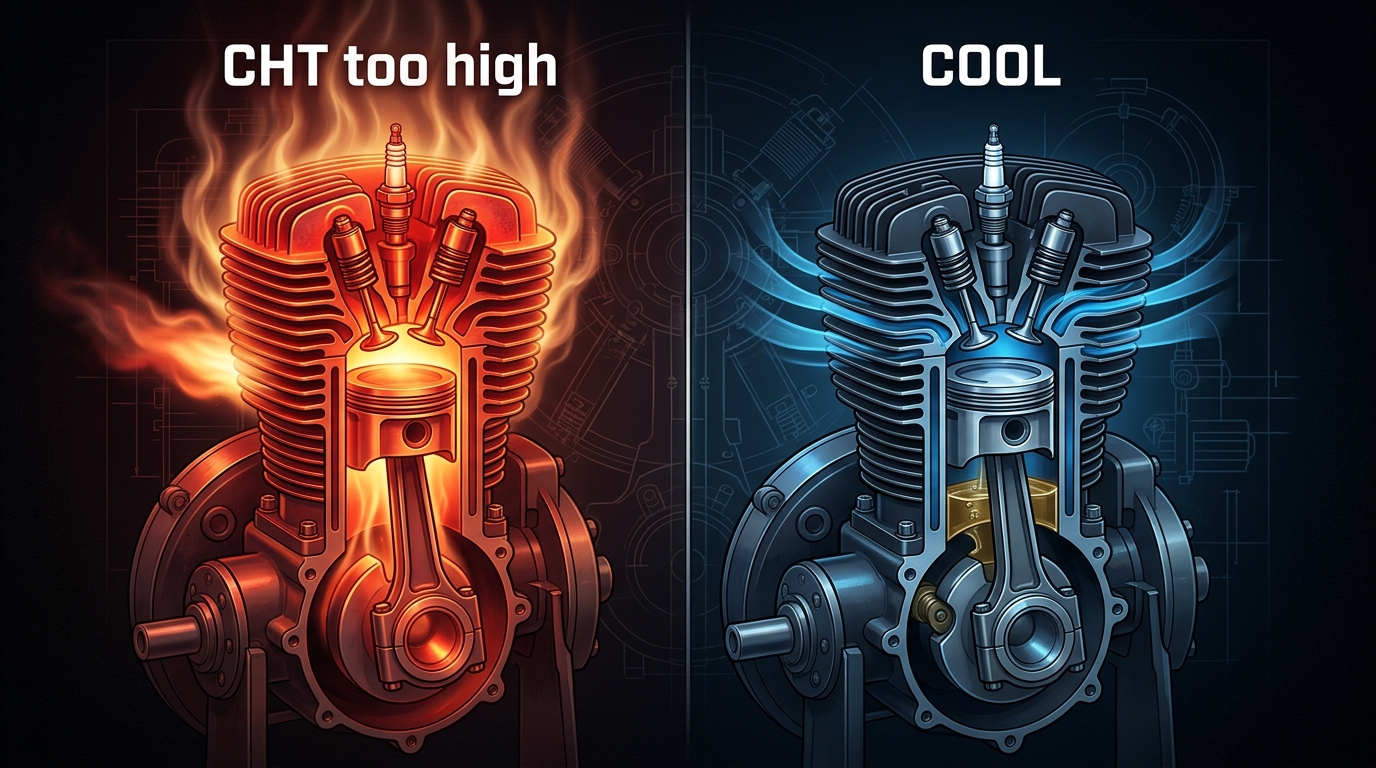
CHT is what tells you about stress. It tracks directly with internal cylinder pressure, the actual mechanical load on your pistons, rods, and bearings.
And the manufacturer red lines? Way too generous.
Lycoming marks CHT red line at 500 degrees F. At that temperature, the aluminum alloy cylinder head has lost three quarters of its strength. Continental's red line is 460, where the head has lost about two thirds.
Busch sets his personal limit at 400 degrees absolute maximum, with a mental "yellow arc" starting at 380.
Above 380, start taking action. Above 400, do something drastic. His engines have run past 200% of TBO. He attributes that directly to keeping CHTs cool.
The red box
There's a range of mixture settings, roughly 20-50 degrees rich of peak EGT, where CHT and internal cylinder pressure both hit their maximum. Busch calls this the red box - the worst place to run an engine during cruise.
Ironically, that's approximately where many older POHs told pilots to operate. "Set mixture to 50 degrees rich of peak." A lot of pilots still fly there because of the law of primacy - first learned, last forgotten.
To stay out of the red box, you either need to be well rich of peak (150+ degrees, which burns a lot of fuel) or lean of peak. For cruise, lean of peak wins because it also saves fuel and runs cooler.
Why leaning actually protects the engine
The spark plugs fire 20-24 degrees before the piston reaches top dead center. The combustion event needs to reach peak pressure at about 15-20 degrees after top dead center. That's the geometric sweet spot where the connecting rod and crankshaft can efficiently convert pressure into rotation.
If peak pressure comes too early, you get excessive stress, excessive heat, and potentially detonation - the fuel-air mixture goes unstable and creates destructive shock waves. If it comes too late, you just lose some power out the exhaust. Not great, but not dangerous.
The connection to mixture management: leaning slows the combustion event, pushing the peak pressure point later. Enriching does the opposite. RPM matters too - lower RPM means the crank is turning slower while the flame burns at the same speed, so peak pressure arrives earlier in terms of crank angle.
This is why reducing RPM and leaning for cruise work well together. The two effects balance each other, keeping peak pressure in the sweet spot.
Lean of peak doesn't burn valves
One of the most persistent myths in general aviation. Running lean of peak will burn your exhaust valves, right?
The opposite is true. High CHT and excessively rich mixtures are the two biggest risk factors for burned valves. Operating lean of peak reduces both. Busch's own engines, consistently flown lean of peak, have made it past 200% of TBO on original cylinders.
Not every engine handles it equally well, though. Fuel injected engines with balanced injectors work best. Most carbureted Lycomings do fine. Some carbureted Continentals, particularly the O-470 in Cessna 182 Skylanes, have poor enough mixture distribution between cylinders that smooth lean of peak operation is hard to achieve.
How Busch actually flies his airplane
Busch flies a turbocharged twin, which simplifies mixture management because the turbo and automatic fuel system compensate for altitude changes. His routine:
Start full rich. Lean aggressively as soon as CHT starts registering - actually leaner than max RPM. Stay leaned through taxi and run-up. For takeoff, everything full forward: full rich, wide open throttle, max RPM.
At 1,000 feet AGL, pull the prop back to 2,500 RPM but leave the throttle wide open. At cruise altitude, pull the mixture way back to lean of peak.
Then he basically doesn't touch anything until landing. Wide open throttle the entire flight - climb, cruise, descent. He says if he could figure out how to land with wide open throttle, he would.
On approach, he throttles back and lowers the gear, but does not go full rich for landing. The POH says to, because lawyers worry about the half-percent chance of a go-around.
If you can't remember to push the mixture forward during a missed approach, you need more practice with a CFI, not a crutch built into your normal procedure.
He lands with the mixture leaned, taxis in leaned, and only touches the red knob to shut down.
This article is based on a Savvy Aviation webinar by Mike Busch. For a much deeper treatment of this subject, Busch recommends the Advanced Pilot Seminars course at advancedpilot.com.
Source: Leaning Basics - Savvy Aviation