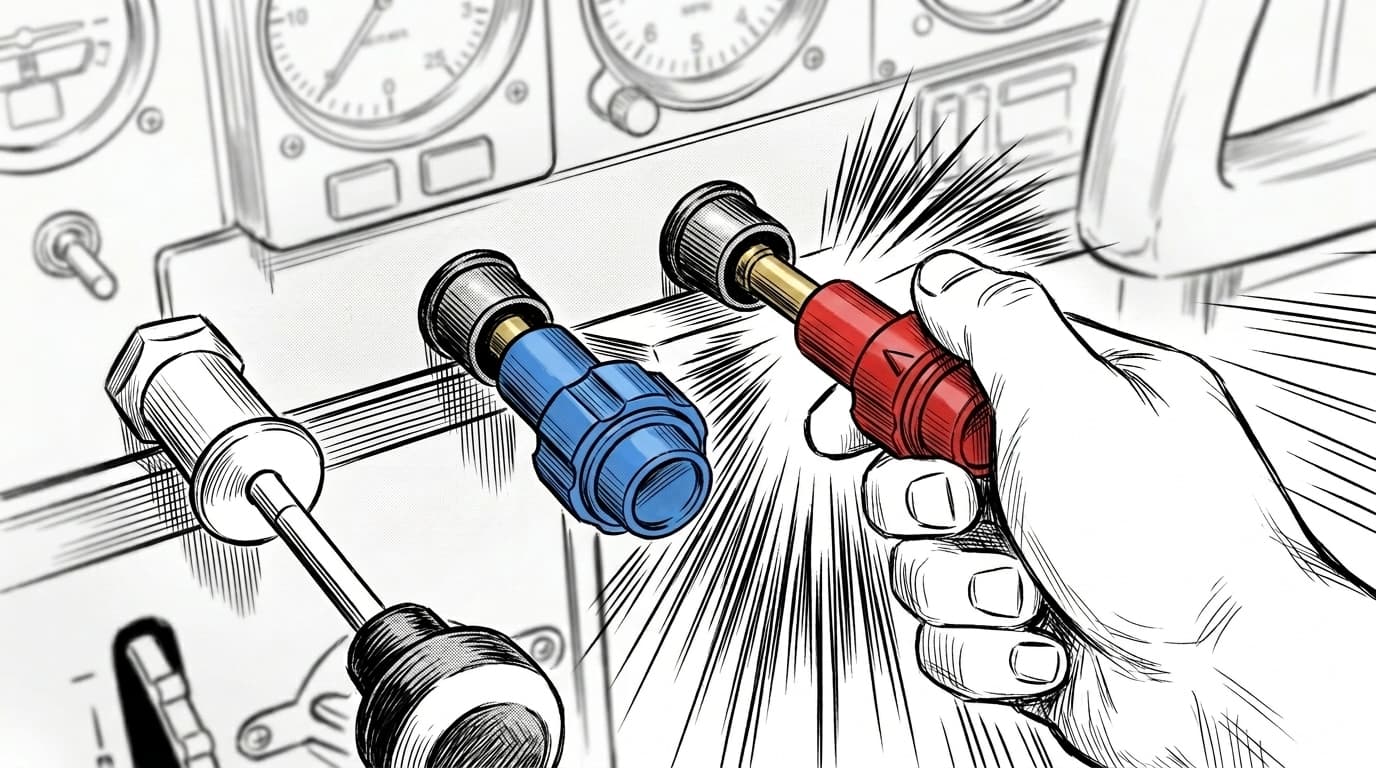
The red fin, the big pull, and other things they didn't teach you about leaning
In the first article we covered the basics: why running full rich is actually abusive, what Embry-Riddle learned the hard way, and why CHT matters far more than EGT. That was the introductory class. This is the advanced one.
Mike Busch of Savvy Aviation followed up his basics webinar with a deeper session that gets into the practical details of how to actually fly a mixture-managed flight from start to shutdown. It also introduces two concepts that change how you think about the red knob: the red box refined, and the red fin.
Quick refresher on the mixture envelope
The combustion range runs from about 1:8 (rich limit) to 1:18 (lean limit). Four points along that range matter: full rich for starting and takeoff, best power around 1:12.5 for maximum horsepower, stoichiometric around 1:15 which is peak EGT, and best economy around 1:16 for maximum range. Going from best power to best economy saves roughly 40% on fuel and costs you maybe 6-7% of airspeed. If you need more detail on any of this, go back to the first article.
The red box, revisited
George Braly at GAMI (General Aviation Modifications Inc.) came up with the red box concept, and Busch refines it further in this session. The red box is the mixture range where CHT exceeds 400F. It's centered at roughly 40-50 degrees rich of peak EGT, which is the single worst place to operate a piston engine. Maximum cylinder pressure, maximum heat.
The red box isn't a fixed size, though. It changes with power setting.
At 75% power, the red box is wide. There's a broad band of mixture settings where you'll exceed 400F CHT. At 65% power, the box narrows considerably. At 60% power, it vanishes entirely. You can set the mixture anywhere you want at 60% power and CHT won't reach 400F no matter what.
The center of the red box is always at that same 40-50 degrees ROP. Which is exactly where a lot of vintage POHs tell pilots to set their mixture for cruise.
"Lean to 50 degrees rich of peak." That instruction puts you in the dead center of the most abusive operating range. Many pilots still follow it because nobody told them to stop.
Refining the 400F number
The 400F target is a good general guideline for most legacy aircraft, the kind with big cowl flaps and cooling systems designed in the 1960s. But it's not universal.
Modern aircraft with more efficient cooling, things like the Cirrus SR22, Diamond DA40, or Cessna Corvallis, tend to run their cylinders hotter for any given operating condition. For these airplanes, 380F is a more appropriate ceiling.
Temperature also matters. The 400F figure assumes standard day conditions, roughly ISA temperatures. On a cold day, your engine is working harder for the same manifold pressure, and the cooling air is also more effective. You should mentally adjust your limits downward when OAT is well below standard.
Busch uses a color-coded mental model. Yellow caution zone starts at 380F. Red line at 400F. And then there's purple, above 420F, which he considers highly abusive. You should never see purple in normal operations, and if you do, something is wrong with your technique or your baffling.
Stop using EGT to lean
Busch argues you should not use EGT as your primary leaning reference. At all. This goes against what most of us were taught, but the reasoning is solid.
To find peak EGT, you have to slowly lean the mixture from the rich side, watching the EGT gauge climb, waiting for it to peak, then continue leaning past it. "Slowly lean from rich" means you're creeping through the red box, dwelling in that 40-50 degrees ROP zone, watching your gauge while your cylinder heads are at maximum stress. You're using the engine as a test instrument to find a reference point you don't actually need.
The same applies to the lean-find modes on JPI, Insight, and Avidyne engine monitors. They ask you to lean slowly while the computer watches for the peak. The computer is asking you to spend time in the red box.
Use CHT and fuel flow instead.
The red fin
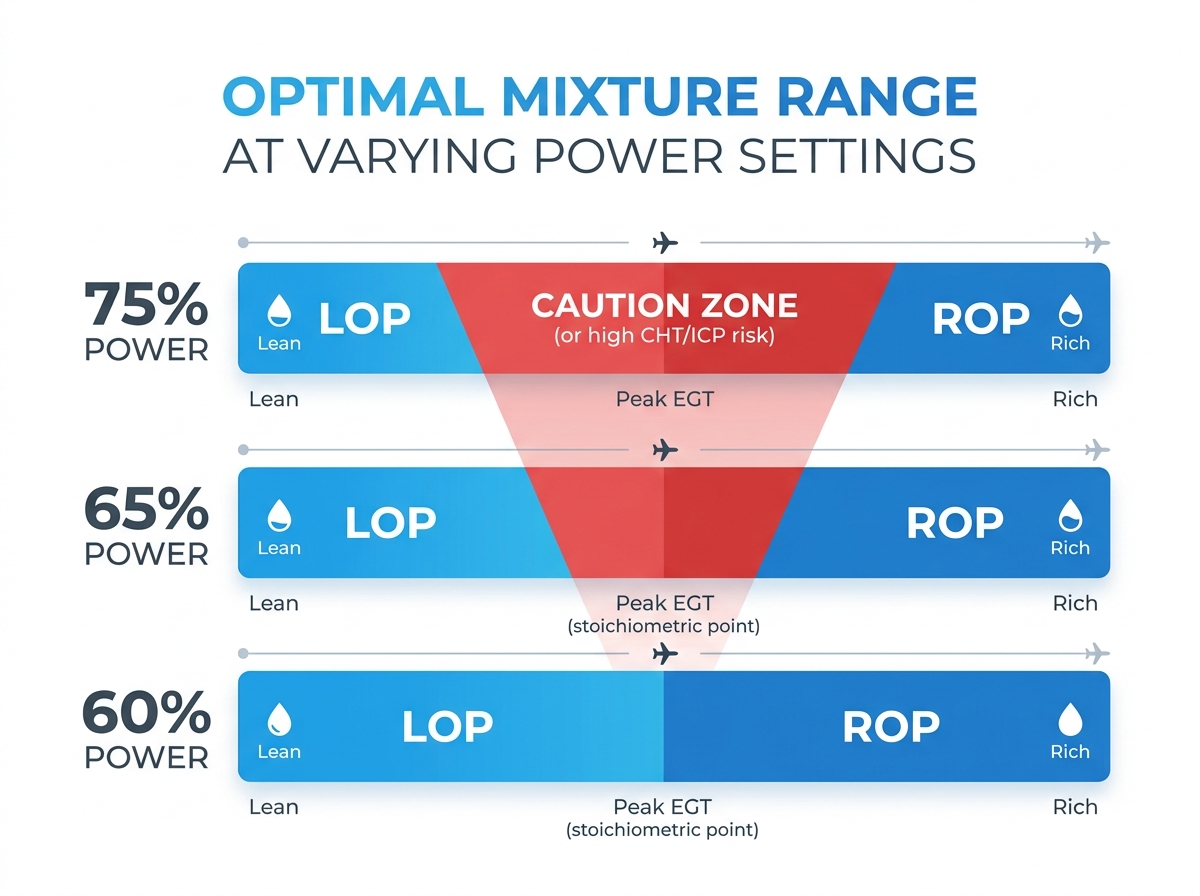
Gordon Fold took the red box concept and stacked multiple power settings together into one diagram. The X axis is percent power (85% down to 60%), the Y axis is mixture (rich to lean). Draw the red box at each power setting.
At 85% the red box is tall, a wide band of forbidden mixtures. It narrows as you reduce power. By 65% it's a thin sliver. At 60% it doesn't exist.
Connect them and the shape looks like a fin, wide at high power, tapering to nothing at low power. That's the red fin.
Two safe zones become obvious. Above the fin you're rich of peak, where you want to be during takeoff and climb. Below the fin you're lean of peak, cool CHTs and good fuel economy. The fin itself is where you don't linger.
Below about 60% power, the fin vanishes entirely. No forbidden zone at all. Set the mixture wherever you want. This matters for descent and for pilots who cruise at conservative power settings.
Walking through a flight
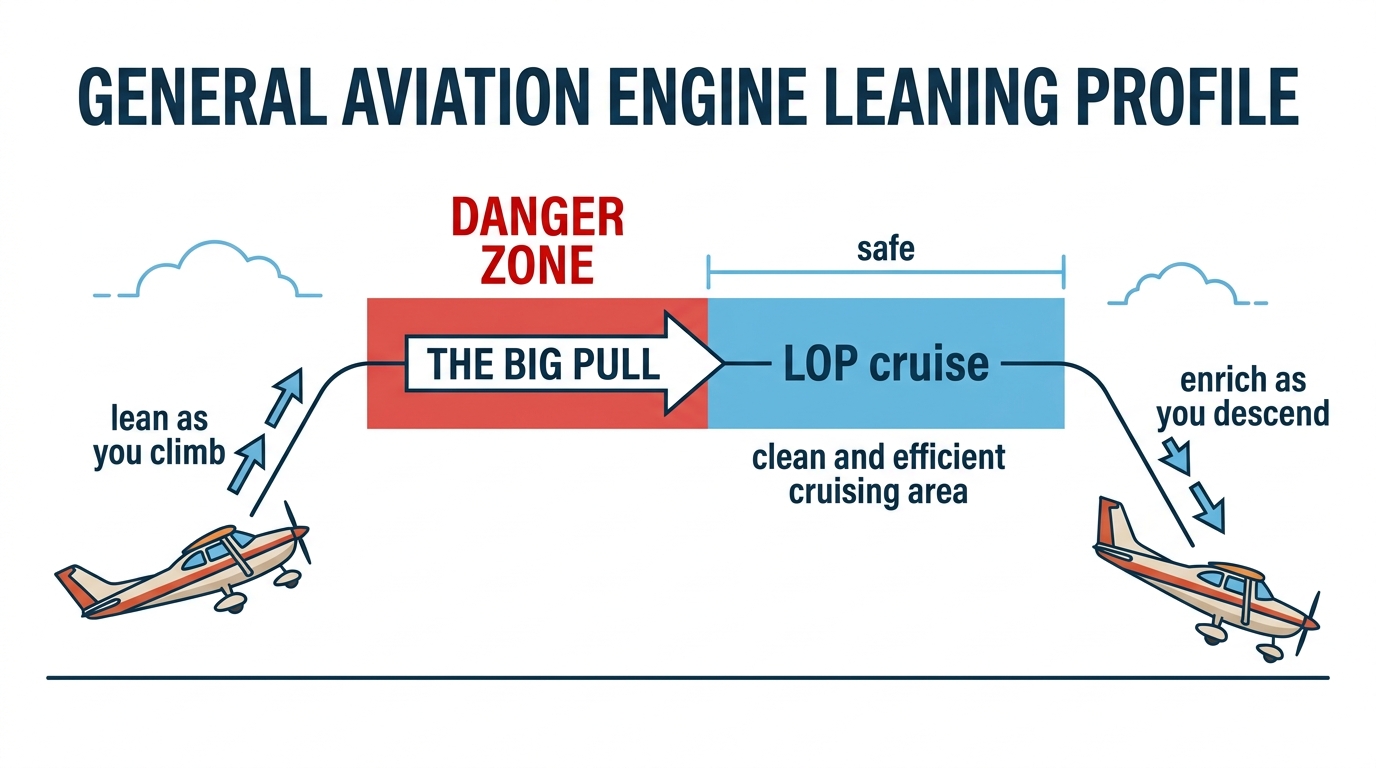
Busch walks through a complete flight using the red fin as a mental model. This is for a normally aspirated airplane.
Takeoff is at full power, mixture full rich (or leaned for max RPM above 3,000 feet density altitude). You're at 100% power and roughly 250 degrees ROP, well above the fin in the safe rich zone.
During climb, the mixture auto-enriches as you gain altitude. The air gets thinner but the fuel metering stays roughly the same, so the mixture drifts richer. Just reach over every 1,000 to 2,000 feet and lean it back a bit to keep CHTs in check. You're still above the fin, in the safe rich zone, so there's nothing to worry about here.
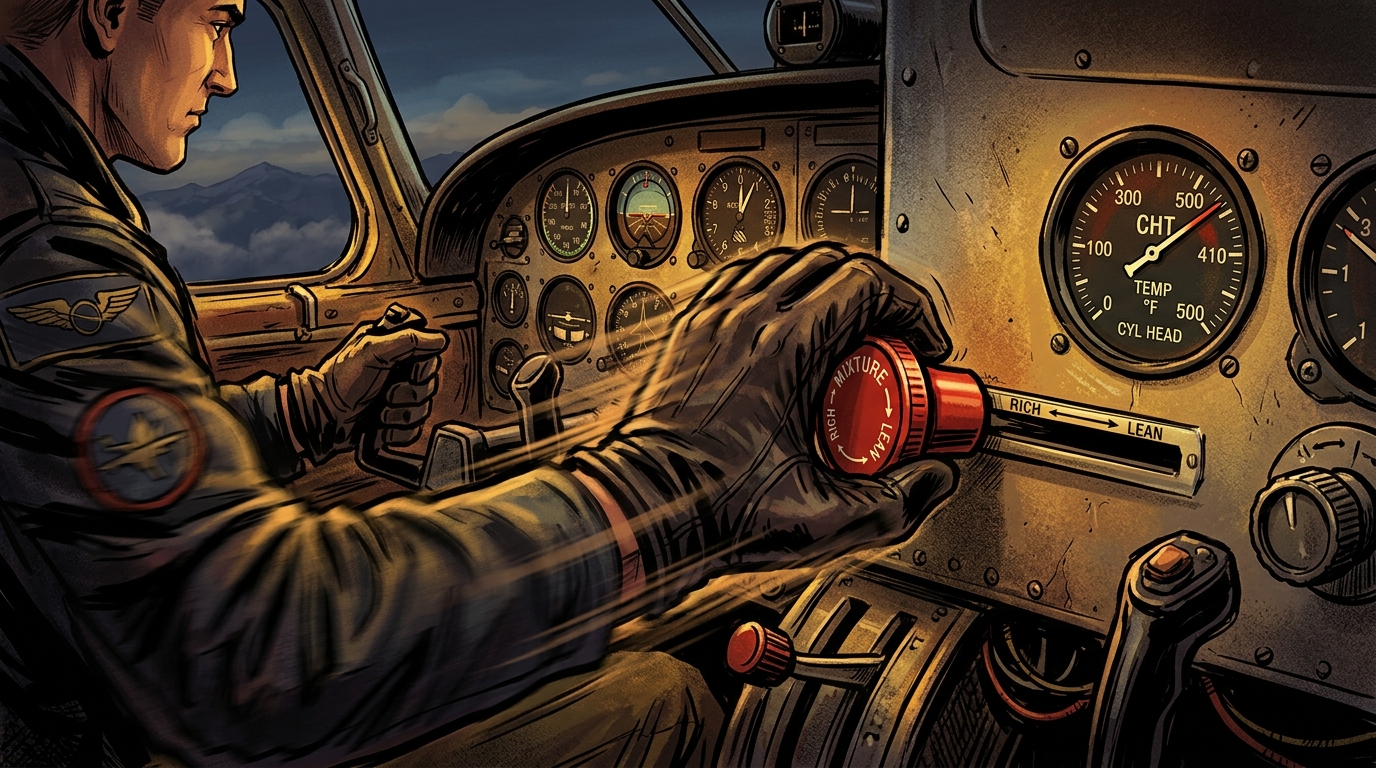
At top of climb, you reduce power to cruise and then comes what Busch calls "the big mixture pull." This is the critical transition. You need to get from the rich side of the fin to the lean side, and you want to cross through the fin as quickly as possible.
There are two ways to do it. The first is to briskly pull the red knob back until you feel the engine lose power, which tells you you're safely LOP.
Two to three seconds, no more. Don't slowly creep through the fin watching your gauges. Just pull it. The second method, if you know your airplane well, is to pull to a target fuel flow that you know puts you LOP. Either way, the goal is the same: minimize time in the red and purple zone.
Once you're LOP in cruise, you're done until descent. Adjust mixture for comfort. Some pilots like 20 LOP, some like 50 LOP. The deeper you go, the cooler and more economical, but at some point you'll feel roughness from uneven cylinder mixture distribution, especially on carbureted engines.
Descent is the reverse problem. As you come down, the air gets denser and the mixture auto-leans. You need to periodically push the red knob forward to avoid running too lean. Not a big deal, but don't forget about it.
Turbocharged airplanes skip most of this. The turbocharger compensates for altitude changes, so the mixture doesn't drift during climb or descent. You still do the big pull at cruise, but altitude-related fiddling with the red knob goes away.
What about detonation?
Pilots worry about detonation when leaning aggressively. They shouldn't. Detonation is almost impossible lean of peak. The highest risk is at 40-50 degrees ROP, right in the center of the red box, where cylinder pressure and temperature peak together.
Busch spent hours in a test cell at Ada, Oklahoma trying to intentionally detonate engines. It's hard. The thermodynamics work against it when you're LOP: lower peak pressures and lower temperatures mean the fuel-air charge just won't go unstable.
Calculating power lean of peak
One useful trick for pilots without a power computer: you can estimate horsepower from fuel flow when LOP. The formula is fuel flow in GPH multiplied by 14.9 for engines with 8.5:1 compression running 100LL. For lower compression engines (7.5:1), use 13.7 instead.
So if you're burning 8 GPH lean of peak in an IO-360 (8.5:1 compression), that's about 119 horsepower. Simple, and accurate enough for practical purposes.
The problem children: carbureted Continentals
Not every engine runs well lean of peak. Fuel injected engines with balanced injectors handle it because each cylinder gets roughly the same fuel-air ratio. Most carbureted Lycomings do fine too.
The troublemaker is the Continental O-470, the engine in the Cessna 182 Skylane. It has notoriously poor mixture distribution between cylinders. One cylinder might be 50 degrees LOP while its neighbor is still 20 ROP. That makes smooth LOP operation difficult or impossible.
Some operators have found workarounds. Avoid wide open throttle, which closes the enrichment circuit and can actually improve distribution. Add a touch of carb heat, which slightly enriches and smooths the mixture. Some C182 operators report successfully running slightly LOP with these tricks. But it's not a guaranteed fix, and the O-470 will probably never run as cleanly LOP as a fuel injected engine.
Odds and ends from the Q&A
If you don't have an engine monitor at all, the old technique still works: lean to the onset of roughness, then enrich just enough to smooth it out. You'll end up somewhere near peak, which isn't perfect but is far better than leaving it full rich.
EGT isn't useless, it's just not for leaning. It's an excellent troubleshooting tool. A fouled spark plug will show up as a 50-75F EGT rise on the affected cylinder, because the remaining plug is firing the charge late. That's easy to spot and easy to act on.
If your airplane has spark plug gasket type CHT probes instead of the standard bayonet well probes, be aware they read about 40F higher. Adjust your mental limits accordingly. Your 400F red line becomes 440F on the gauge.
Mag timing has a bigger effect on CHT than most pilots realize. Lycoming actually changed the recommended timing on the IO-360 from 25 degrees BTDC to 20 degrees BTDC specifically to address high CHT and detonation complaints. If your engine runs chronically hot, timing is worth investigating.
The red fin boils down to three rules: above the fin for takeoff and climb, below the fin for cruise, through the fin as fast as you can.
Most of this goes against what we were all taught. But Busch's data, tens of thousands of engine teardowns, tells a consistent story.
The engines that make it to 200% of TBO are the ones flown LOP with CHTs under 380. The ones that fail early are the ones parked at 50 degrees rich of peak because that's what the 1975 POH said to do.
This article is based on the Savvy Aviation advanced leaning webinar by Mike Busch.