Scott Ashton opens his oxygen seminars with a recording. It is a few minutes of radio traffic between a Cleveland Center controller named McCombs and a jet flying as Kalitta 66, whose cabin had been slowly failing to pressurize on the climb. There was no bang and no sudden decompression. The cabin just never got to where it should have been, and the crew went up with it.
McCombs does everything right. He tells the pilot his mic is sticking on and asks whether they can maintain altitude and what help he can give. Another pilot on frequency relays that Kalitta is declaring an emergency with his flight controls. The voice coming back from the cockpit asks for vectors to Ypsilanti, and then delivers the line that made the tape famous:
Unable to control altitude. Unable to control airspeed. Unable to control heading. Kalitta six six. Other than that, everything A-OK.
By then the co-pilot had passed out. The captain was alert enough to know he could not control the airplane, and still sure that everything was fine. That, Ashton says, is the most chilling part of the recording. You can be awake, talking on the radio, and functionally incapacitated, and the person least able to tell is you.
Ashton is president of Aerox, the Florida maker of portable aviation oxygen systems, as well as a FAASTeam rep, CFII and ATP. The Kalitta crew was up in the flight levels, but his argument is aimed at the rest of us: unpressurized pistons at eight, ten and twelve thousand feet, perfectly legal, and a fair few of the pilots hypoxic.
The rule everybody learned
Every private pilot memorizes 14 CFR 91.211. It says that no person may operate a civil aircraft of U.S. registry:
(1) At cabin pressure altitudes above 12,500 feet (MSL) up to and including 14,000 feet (MSL) unless the required minimum flight crew is provided with and uses supplemental oxygen for that part of the flight at those altitudes that is of more than 30 minutes duration;
(2) At cabin pressure altitudes above 14,000 feet (MSL) unless the required minimum flight crew is provided with and uses supplemental oxygen during the entire flight time at those altitudes; and
(3) At cabin pressure altitudes above 15,000 feet (MSL) unless each occupant of the aircraft is provided with supplemental oxygen.
Add the knowledge test question that asks you to pick the definition of hypoxia ("a state of oxygen deficiency in the body") and for a lot of pilots, instrument rated ones included, that is the entire training on the subject. The AIM, section 8-1-2, chips in with the reassurance that "other significant effects of altitude hypoxia usually do not occur in the normal healthy pilot below 12,000 feet."
What sticks, thanks to the law of primacy, is that oxygen starts mattering at 12,500 feet and not before.
Where 12,500 came from
You would expect a number like that to rest on some physiology. It doesn't.
The rulemaking notice went out in the late 1960s and the rule became final in the early 1970s. During the comment period someone suggested matching Part 91 to Part 135, which brings oxygen in at 10,000 feet. The FAA said no. The reason, as Ashton tells it, was that the agency wanted pilots to have one more VFR cruising altitude they could use without carrying oxygen.
In other words, convenience: 11,500 and 12,500 stayed available for a coast-to-coast trip without a bottle in the back.
So a Cherokee Six flown on a Part 135 charter needs oxygen above 10,000 feet for anything over half an hour, and the same airplane flown privately can sit at 12,500 until the tanks run dry. European rules under EASA also bring oxygen in at 10,000 feet. The pilot's lungs are identical in all three cases.
91.211 is one of the few regulations where being legal does not mean you are safe. Most safety rules have a margin built in. This one doesn't.
What the blood says
The way to measure any of this is SpO2, the percentage of your hemoglobin that is carrying oxygen. A healthy person at sea level sits in the high 90s. The doctors Ashton has talked to start to worry at 90%, so that is where he draws his red line.
He showed a chart that traces back to a 1981 Flight Safety Foundation bulletin by Dr. Stanley Mehler, plotting typical SpO2 against altitude. Real people scatter around a curve like that, but its shape is plain enough. It starts at 98% on the ground, is down to 95% at 5,000 feet and 93% at 7,500, and crosses 90% a little above 9,000 feet. At 12,500, the altitude the rule treats as fine indefinitely, it reads about 87%. By 14,000, where the rule finally insists, it is around 83%.
Ashton's own testing, and the FSF data, show some people dropping below 90% as low as 8,000 feet.
Why should saturation fall at all, when the air at 12,000 feet is still 21% oxygen? Ashton deliberately leaves partial pressure out of his talk, but the short version helps. The percentage never changes. The pressure does, and pressure is what pushes oxygen across the lungs into the blood. At 18,000 feet the atmosphere is at half its sea-level pressure, so every breath carries half as many oxygen molecules.
The slider marks the FAR altitudes and the thresholds Ashton actually flies by. From 18,000 feet up it adds the FAA's time of useful consciousness, which shrinks from half an hour to a minute or two by 30,000.
What a little hypoxia does
The other reference Ashton leans on is SAE AIR825, an engineering guideline for oxygen equipment that Aerox uses in its own design work. Its table of effects has nothing to do with legal limits.
At 5,000 feet, night vision is impaired, and colour vision especially. This is the one most pilots have heard of.
Between 8,000 and 10,000 feet, after more than an hour, you get "detectable behavioral changes", complex cerebral functions begin to deteriorate, and night vision is significantly impaired. Two hours at 9,500 feet followed by a busy arrival and an approach is exactly that situation.
At 12,000 feet, fifteen minutes is enough for "considerable performance decrements". Part 91 gives you twice that long at 13,000 feet before it asks for anything.
Have oxygen with you above 8,000 feet, and use it from as low as 5,000 feet at night. That is Ashton's recommendation. The FAA's is a lot looser.
And the threshold moves, between people and from day to day. Weight, smoking, fatigue, stress and plain dehydration all make you more susceptible, so an hour at 10,000 feet that felt fine last week can go quite differently when you are tired and short of water.
The pilots who were legal
Ashton reads NASA Aviation Safety Reporting System reports in his spare time, which is a habit any instructor could stand to pick up. He pulled out a handful about hypoxia. With one exception, every one happened at or below 12,500 feet.
One pilot was climbing out of about 6,500 feet when he noticed confusion, short-term memory loss, shortness of breath and blurred vision. He was nearing his assigned 9,000 feet. He asked for lower straight away and got 7,000.
Another had been cruising VFR with flight following at 12,500 feet for about four hours. On the way down, he wrote, even the simplest mental tasks became almost impossible, and he blundered into Class B airspace without a clearance. He was 73, in excellent health, had never smoked and did not drink. His own conclusion: prolonged flight even at the legal altitude of 12,500 can badly hurt your mental capacity.
A third came down from 11,500 feet, struggled to follow the tower's instructions, and only realized afterwards why. A fourth spent 40 minutes at 10,000 feet and suspected residual mild hypoxia afterwards. He resolved never again to ask for anything above 8,000 feet without oxygen if IMC might follow.
Then there is the retractable single with no altitude hold, cruising at 12,000 feet for range, oxygen on board and not in use. About four hours in, ATC asked for his altitude and he couldn't believe his eyes: 11,300 feet. He had lost 700 feet without noticing. He went on oxygen, descended to 6,000 and felt fine. He was a non-smoker who walked twenty miles a week, skied, and knew hypoxia from the military. "I was sure that I could recognize lack of oxygen but I was wrong," he wrote. "It was very insidious and I had no indication that anything was amiss."
The exception is the most useful of the lot. That pilot had been cleared to FL180, and ATC pointed out he was 200 feet low because he had forgotten to reset his altimeter. He also checked his pulse oximeter. It read 72%. His oxygen line had come apart and he had felt nothing at all.
What it feels like, if you feel it
"Hypoxia need not be symptomatic" is on one of Ashton's slides, and the ASRS reports bear it out. When there are symptoms, they tend to arrive after landing. Fatigue. A pounding headache. Driving home feeling foggy. Ashton had all three earlier in his flying and put them down to dehydration. Since he started using oxygen at altitude, he says, he lands awake, and pilots and customers keep telling him the same thing.
A symptom list only goes so far when hypoxia takes away the judgment you need to act on it. Better to meet your own symptoms on the ground. A PROTE, a portable reduced oxygen training enclosure, takes up to five trainees to a simulated 25,000 feet by adding nitrogen to the air instead of lowering the pressure. They turn up at events like Sun 'n Fun, and the FAA chamber in Oklahoma City does the full version. One webinar attendee who had been through it called it very humbling. Taken through an FAA Safety Team event, it can count toward WINGS.
The thirty dollar instrument
If you change one thing after reading this, put a pulse oximeter in your flight bag. They used to cost a couple of hundred dollars; now they cost about thirty, and plenty of smartwatches measure SpO2 as well. Some clip to the earlobe and stream to a phone app. Ashton recently flew his 172 to 10,000 feet with Aviation Consumer and watched the numbers fall in real time on the climb.
Check it every half hour or wear it continuously, and remember that bright light and cold fingers can throw the reading off.
There is one blind spot that surprised Ashton when a surgeon friend pointed it out. Carbon monoxide binds to hemoglobin, and an ordinary pulse oximeter cannot tell hemoglobin carrying oxygen from hemoglobin carrying CO. With an exhaust leak in the cabin, your SpO2 can look normal, or even go up, while you are being poisoned. So the oximeter needs a partner, which is a CO detector.
The hardware
Some pressurized singles carry chemical oxygen generators, good for ten or fifteen minutes during an emergency descent. Bigger airplanes have installed systems with a port at each seat. Most GA pilots who use oxygen fly with a portable.
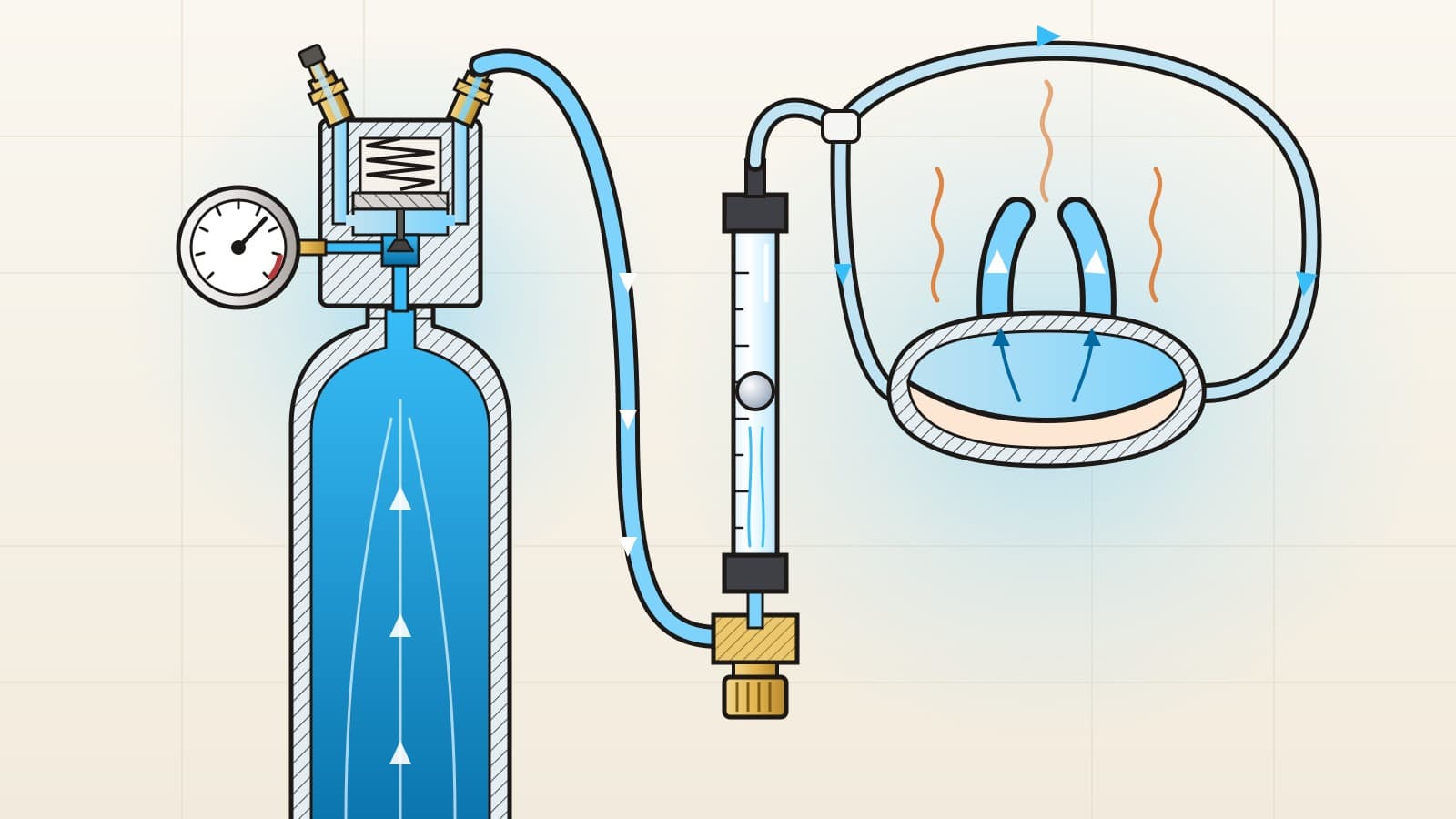
A portable is a cylinder, a regulator, cannulas and a mask. The regulator screws onto the cylinder and brings the bottle pressure, about 1,800 to 2,200 psi when full, down to between 10 and 50 psi. Aerox's has a self-sealing quick disconnect for each seat, so a four-place regulator works fine with one person plugged in.
Aerox's cylinders run from the 6 cubic foot A through the C (9), D (13) and M (22) to the 24 cubic foot E. An A or a C is probably plenty for occasional use; owners of faster, higher-flying airplanes tend to want an M.
Cylinders answer to the Department of Transportation, not the FAA. Portable aluminum cylinders need a hydrostatic test every five years and have no life limit, so a twenty-year-old bottle is still good. Kevlar-wrapped composite cylinders, found in some Mooneys and Cirruses, also test every five years (the interval went up from three in 2008), but they expire after 15. An overdue hydro does not mean emptying the bottle: oxygen doesn't go off, so breathe what is in there and get the test done before the next fill.
Bolting a cylinder bracket into a certified airplane is a modification that needs a 337 or a field approval unless it is part of the type design. A bag strapped to the back of a seat avoids the question.
Cannula, conserver, mask
Up to 18,000 feet most pilots use a nasal cannula. The Part 23 certification rule Ashton cites, 14 CFR 23.1447, set the cannula limit there.
A plain cannula is the hospital kind: oxygen flows into your nose all the time. The trouble is that you spend most of every breath breathing out, and whatever arrives during the exhale gets blown back into the cabin.
A conserving cannula adds a small reservoir that fills while you exhale. The stored oxygen goes in first on the next breath, and the start of the inhale is the part that travels deepest into the lungs. Aerox makes two styles: the mustache type has the reservoir right under your nose, and the pendant type hangs it lower on the tubing. Ashton wears the mustache type on trips to Key West in his 182 and says he forgets he has it on.
Clean a cannula with alcohol wipes on the outside only, never let liquid into the fine tubing, and replace it at around 200 hours before the vinyl turns brittle.
Even if you never go above 18,000 feet, carry a mask. A passenger with a blocked nose can't use a cannula, and neither can you on the day you have a cold. A mask is continuous flow, so it goes through oxygen a lot faster.
Above 18,000 the limits step up. Continuous-flow masks are good to 25,000 feet. Above that you need a diluter-demand mask, which mixes oxygen with cabin air, has a 100% setting and comes in quick-donning versions with an inflating harness. That is turboprop and light jet territory, and those masks are good to 40,000 feet. Above FL400 even pure oxygen won't get into your blood unaided, and a pressure-demand mask has to force it in.
Close the loop
Some regulators have a fixed altitude setting that gives everyone the same flow. Pulse systems, electronic or mechanical, meter oxygen as you inhale. Aerox uses a needle valve and a ball flow meter with two altitude scales, one for the conserving cannula and one for the mask.
None of those scales is the answer, according to Ashton. They are a starting point. What you are really trying to control is the oxygen in your blood, and the pulse oximeter is how you close the loop. Set the flow meter for 10,000 feet and read your SpO2. If it shows 93% and you want more, open the valve a bit. You will use oxygen a little faster, which is what it is there for.
There is no glory in conserving oxygen and sitting at 90%. There is no partial credit. If you need more, use it.
Two people on the same flow can read quite different numbers, which is the weakness of a regulator that gives everyone the same dose. The response is quick: in Ashton's testing, SpO2 started to climb almost as soon as the oxygen went on.
A Bluetooth pressure transducer on the cylinder adds another check. It turns the rate of pressure drop into time remaining and shows the trend as a straight line. If the line suddenly steepens, a hose has probably come off. If it flattens, look for a kink.
How long will the bottle last
Customers ask this more than anything else. The answer depends on altitude, how many people are breathing and what they breathe through. Aerox publishes a duration table for its conserving cannulas. Two people at 10,000 feet get about 13 hours from a D cylinder and about 23 from an M. At 18,000 feet the flow per person is more than two and a half times as high, and the hours shrink to match.
The table assumes everyone has the flow meter set to the altitude. A passenger who cranks the valve open for the rush of oxygen will cut it short. Ashton's tongue-in-cheek fix is to unplug them and let them have a nap. The serious version is to keep the crew on separate supplies. Some owners of club-seat Bonanzas carry one small system up front and another in the back, so a careless passenger never eats into the pilot's oxygen.
Check it like a fuel tank
Learn the system at home before you need it: cannula on, SpO2 measured, valve found without looking. Then before each flight run the PRICE check, to which Ashton adds his own E:
- Pressure: enough oxygen in the bottle for the flight.
- Regulator: clean, with couplings and quick disconnects moving freely.
- Indicator: turn it on and see the flow meter ball lift off the bottom.
- Connections: secure and leak-free. Tug on every one. Soapy water on the joints shows a leak as bubbles, and in a quiet hangar you can often hear one.
- Emergency: ready and within reach, with passengers briefed on putting on a cannula and opening the valve.
- Electricity: charged batteries in the oximeter, any pulse system and the pressure transducer.
In flight, keep checking your SpO2 and glance at the flow meter every 15 minutes or so. The pilot at FL180 found his disconnected line because he looked.
Filling it yourself
FBOs typically charge somewhere between $40 and $80 to fill a bottle. Ashton sees that price as a safety problem, because it turns oxygen into something you ration, and he would much rather pilots filled their own.
It can be done safely, with respect. A cylinder at 2,200 psi stores a lot of energy, and the gas inside feeds fire, mostly on the high-pressure side. Keep oil and grease away from it all (Aerox allows none in its shop), cap a cylinder that has no regulator fitted, and don't drop it. Fill slowly, because gas heats as it is compressed, and in pure oxygen that heat, or a speck of grit rubbing through a valve, can ignite the aluminum itself. Aerox fills at about 200 psi per minute, which works out to ten minutes from 200 psi to full.
The usual hangar setup is a cascade: two to five big cylinders from an industrial gas supplier at different pressures. You fill from the emptiest first and step up to the fullest, which gets far more out of them than one big cylinder that stops once the pressures equalize. Chain them to the wall, and ask the supplier for the CGA-540 fitting that portables generally use.
On welding oxygen, Ashton's view is that oxygen is oxygen. It is all made by cooling air until the oxygen liquefies, and he notes that the welding standard actually demands higher purity than aviator's breathing oxygen. Under Part 91 the choice is yours, and he fills from a welding supplier himself. Part 135 and 121 operators must use aviator's breathing oxygen.
A full bottle left in a hot airplane is not a bomb either. The valve has a burst disc that lets go somewhere above 3,000 psi, so you get a loud hiss and an empty bottle, not shrapnel. If it happened while you were away, the P in PRICE is how you find out.
The cheapest performance mod you can buy
Ashton calls portable oxygen the ultimate low-cost bolt-on mod. A system runs about $400 to $800 depending on bottle size and accessories. In return you get the altitudes where true airspeed is higher, the tailwinds blow, and over open water the glide reaches a lot further. In Florida it can be 50°F at 10,000 feet when it is 90 on the ramp.
Mostly, though, he talks about how you feel when you land. He has friends who brag about flying at 15,000 feet without oxygen and feeling fine, and he can't see the point. You can hold your breath for five minutes too. Great. Why would you?
The 12,500 foot rule was written for convenience half a century ago, and your blood doesn't care what it says. Measure your SpO2, keep it above 90%, and put the cannula on before you think you need it, because hypoxia is going to tell you that everything is A-OK.
This article is based on the Cessna Flyer Association webinar Complete Guide to Supplemental Oxygen Use for General Aviation by Scott Ashton.