In April 2014 a pilot who was also his own mechanic noticed the oil pressure on his Cessna U206G flickering in flight. He did the right thing. He landed, changed the oil, and cut open the filter.
There was a lot of metal in it. The NTSB report later called it "an excessive amount." People at the airport looked at it and told him they would not fly the airplane like that.
He had replaced four of the engine's six cylinders about four months earlier, and he decided the metal was left over from break-in. He finished the oil change and took off. Roughly 30 minutes later the engine made what the report calls "a strange sound," and about 20 seconds after that it quit. The forced landing near Louisa, Virginia, wrote off the airplane and left one person seriously hurt.
When investigators took the engine apart they found the through-bolts significantly under-torqued. Main bearings number one, two and three had shifted in their saddles. In the hangar the word for that is spun.
Mike Busch, the A&P/IA who runs Savvy Aircraft Maintenance Management, opened an EAA webinar with that accident and a second, worse one, and then said the thing he says a lot: he hates pulling jugs, because it is risky business. What bothers him most is that most owners, and a fair number of mechanics, have no idea how much can go wrong when a cylinder comes off an engine and goes back on.
The second accident
The other case is from June 2013, a Beech A45 Mentor near Boulder City, Nevada. Once again the pilot was also the mechanic, and he had just replaced all six cylinders during the annual. A top overhaul, in other words.
The engine was run three days before and seemed fine. On the day of the accident he flew to another field to have the wings inspected, and on the way home the chip light came on. He declared an emergency. Shortly afterwards one cylinder went cold, and with the engine shaking on five the airplane hit terrain nose-low about a mile from the airport. Both people on board were killed.
The number six cylinder had separated from the engine. The crankcase deck under it showed fretting, the polished wear you get when two surfaces that should be clamped solid are rubbing against each other, which meant the cylinder had been moving for a while before it let go. The engine had barely run since the cylinder work, so the NTSB concluded that the hold-down fasteners never had the right preload in the first place.
Both engines came apart at the fasteners holding the new cylinders on.
A crankcase held together by cylinder bolts
Car engines have their cylinders bored into the block. On a Lycoming or a Continental each cylinder is a separate assembly bolted to the crankcase, usually with eight fasteners around the base flange: four above, four below.
Most of those eight are deck studs, threaded into the case and doing one job. They hold the cylinder down. In the most common arrangement two of the eight are something else. They are through-bolts, long rods that run straight through both halves of the crankcase and come out the far side, where they serve as hold-downs for the opposite cylinder as well.
That gives a through-bolt three jobs. It holds down the cylinder on one side, it holds down the cylinder on the other side, and it clamps the two crankcase halves together at the place where clamping matters most, right beside the main bearing supports. A Continental six has eight of them. The small bolts around the edges of the case seam do not hold the engine together in any meaningful way. The through-bolts do.
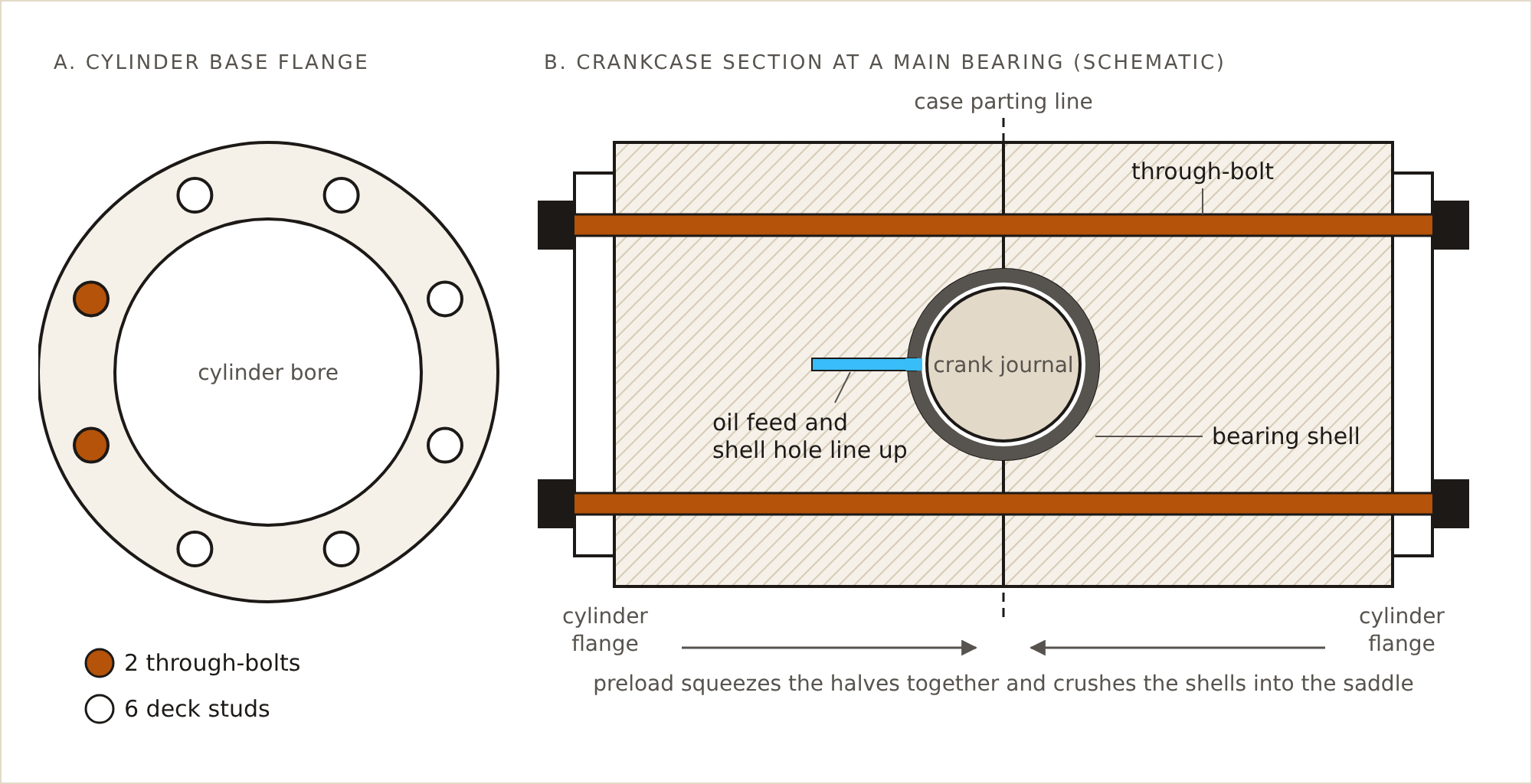
The bearings themselves are held in place by clamping and nothing else. A main bearing shell is made very slightly larger than its saddle, a difference called crush, so when the case halves are pulled together the shell is squeezed into an interference fit and cannot move. Each shell also has an oil hole that has to line up with the oil passage drilled into the case. Lose the clamp and the shell can rotate in its saddle. Once the holes stop lining up the bearing runs short of oil, and from there things go bad very quickly.
What preload actually does
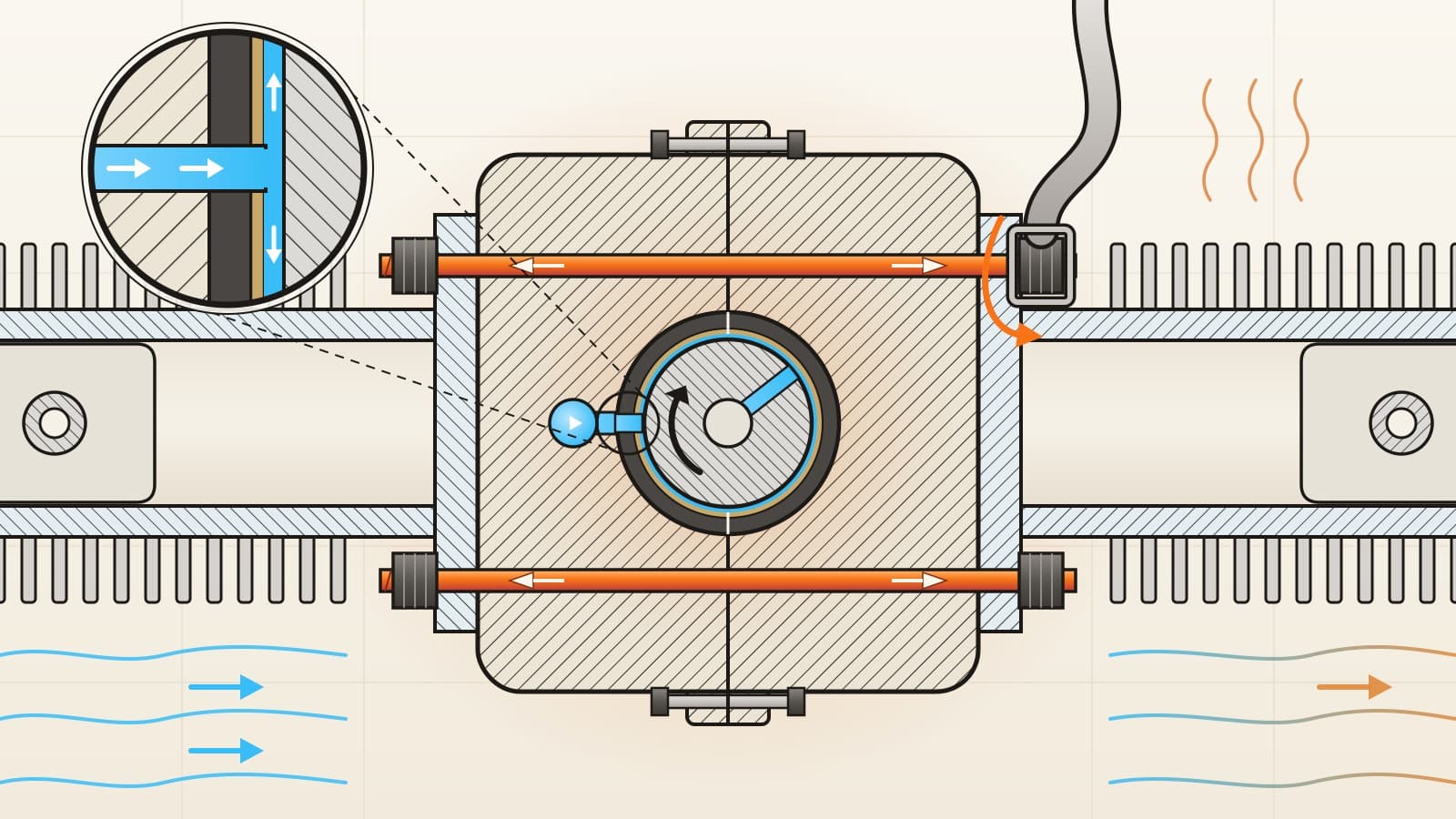
Tightening a fastener stretches it, and a stretched bolt pulls the joint together with a force called preload.
Busch explains it with a fish scale. Hook a spring scale to a ceiling, pull it down to 1,000 pounds, and wedge a solid block under the hook so it stays there. Now hang weights on it. Anything up to 1,000 pounds and the needle does not move, because the block is carrying the load and the spring never notices. Go past 1,000 and the hook finally lifts off the block, and from then on every extra pound shows up on the scale.
His slide adds the condition: a bolted joint behaves the same way as long as the parts being clamped are much stiffer than the bolt. While preload is bigger than the largest load the joint ever sees, the bolt carries a steady tension and never feels the engine firing. If the load gets bigger than the preload, the joint opens a little on every power stroke. The surfaces rub, which is fretting, and the bolt starts taking the full load once per firing cycle. Bolts that see that kind of cycling eventually break from fatigue.
Too much preload is almost never the problem. Busch said he has never heard of one of these fasteners being over-torqued to the point of yielding. Every failure he knows of came from too little.
Why the torque wrench does not tell you the preload
So the number that matters is stretch. You could measure that directly with a micrometer, and on some fasteners mechanics do: Lycoming connecting rod bolts are commonly tightened until they have stretched by a specified few ten-thousandths of an inch. A cylinder hold-down nut or a through-bolt gives you nowhere to put a micrometer, so the industry tightens them by torque and trusts that a given torque produces a given preload.
The weak point in that arrangement is friction. On a dry steel bolt, Busch's slide shows about half the torque you put into the wrench being spent overcoming friction between the nut and the surface it turns against. Roughly 40% more goes into friction in the threads. What is left, under about 10%, actually stretches the bolt.
Tighten a dry steel bolt and something like nine tenths of the effort goes into friction. Only about one tenth ends up clamping anything.
When most of the torque is lost to friction, small changes in friction make large changes in preload. Worn threads add friction. So does worn cadmium plating. Engine fasteners are cad-plated steel partly against corrosion and partly because cadmium is slippery, and once the plating has worn through, more of the wrench goes into friction.
According to Busch, cylinder studs are never replaced in the field. Through-bolts almost never are either, because swapping one on an engine that is still hanging on the airplane is a major job. The cylinder may be brand new, but it goes back on over threads that have been torqued and loosened before and lost much of their plating. The factory built the engine on new threads. The mechanic in your hangar is working with whatever is left of them.
Wet means wet
The answer is lubrication, and Continental and Lycoming both require cylinder hold-down studs and through-bolts to be torqued wet. The torque values in the manuals assume lubricated threads. Busch's slide plots preload against torque for dry threads, light oil and moly grease. At the same wrench setting the greased bolt ends up with roughly three times the clamping force of the dry one. The simple model in the figure above gives a smaller gap, about double, but it points the same way.
Mechanics tend to go easy on it anyway. Lubricant is messy, nobody likes oil running down the side of an engine, and most were never shown how much difference it makes. Busch's instruction is that the threads and the face of each nut where it bears on the flange should be "slathered and dripping."
The two manufacturers do not specify the same lubricant. Continental calls for 50-weight engine oil. Lycoming, as Busch recalled it, calls for a 90/10 mix of 50-weight oil and STP, which works as an anti-scuff additive. His own preference is aviation oil with an anti-scuff additive in it: AeroShell W100 Plus, straight oil with Lycoming's LW-16702 additive, or oil with CamGuard. Moly grease is the slipperiest thing on his chart, but neither manufacturer mentions grease, so he sticks to oil.
Wrong lubricant is not the only way to ruin the joint. Busch has seen cylinders come loose because someone painted the flange or the deck, and he once wrote a full article on a fatal accident where a mechanic had put sealant on a Continental cylinder base O-ring. That joint has to be clean metal against metal with nothing but engine oil on the O-ring. Continental's service manual did not spell that out clearly at the time of the accident. Busch says it now does, in capitals and inside a box.
Swinging the wrench
None of the A&P training Busch went through covered how to actually operate a torque wrench, and he has never found a course that does.
With a click-type wrench, which most mechanics use, you have to reach the click in one smooth pull. If you creep up on it in short bites, stopping and restarting, every restart has to overcome static friction, which is higher than the friction of a nut that is already turning. The wrench can click before the fastener has reached the right preload. The result is under-torque even though the wrench said the job was done.
On an engine stand that smooth pull is easy. Under the cowling, with exhaust pipes, engine mount tubes and baffles in the way, it is much harder, and that is where field cylinder work gets done. The nuts are reached with cylinder base wrenches, offset wrenches with a curved arm that clears the fins and keeps the socket in line with the drive so no correction is needed. Crow's feet and right-angle adapters are not an approved way to torque these nuts.
The specified values are serious numbers. Busch said the current through-bolt spec on his big-bore Continentals is 800 inch-pounds with a 12-point nut. By his account it used to be 600, Continental raised it after some engines came apart, and the switch from six-point to 12-point nuts was needed because the old nuts stripped at the new torque. Savvy has seen some of those nuts crack under it.
What a loose bearing looks like
Savvy saw this up close on a Cirrus SR20 belonging to a client, a flight school airplane that had recently had cylinder work. A routine oil change turned up metal in the filter. They sent a sample for scanning electron microscope analysis, and the lab said it looked like crankcase material.
Crankcase metal in the oil meant something inside was fretting, so they tore the engine down. A main bearing saddle was covered in fretting, the steel bearing shell had been working back and forth against the softer aluminium, and the oil holes had drifted out of line. The bearing showed accelerated wear from oil starvation, and the crankshaft journals had scoring that meant oil to the rod bearings was being choked off too. Busch's estimate was that the engine had perhaps another ten hours before it came apart in the air, with a student and an instructor on board.
The end of that road is a thrown rod. One of his slides shows a Continental that threw one after a bearing spun.
The 206 pilot had a warning before he ever saw the metal: the oil pressure flickering in flight. Busch's rule on that is simple:
Cruise oil pressure should be rock solid. Only a few things make it fluctuate in flight, and all of them are bad.
The two usual causes are a sizeable chunk of metal passing through the oil pressure relief valve, which means there are big pieces loose in the oil system, and a main bearing that has shifted. Either way, he says, get on the ground, then cut open the filter and look at the suction screen. Slow drift that follows oil temperature is normal, and a digital readout flickering between two adjacent values is just the display rounding. Rapid fluttering is not.
Why two jugs are worse than one
Busch's headline warning is about changing more than one cylinder at a time, and a top overhaul, all of them at once, is the extreme case. During the Q&A an attendee pushed back: if two opposing cylinders share the same pair of through-bolts, why would changing both be any riskier than changing one?
Busch agreed, and said he should really be talking about how many pairs of through-bolts are loosened at once, since that is where the danger lies. Pull one cylinder and its through-bolts go slack, but the rest of the engine is still clamped tight. Pull them all and every through-bolt is loose, and in his words there is essentially nothing holding the engine together except the small bolts along the edges of the case.
If somebody then turns the propeller, the crankshaft drags on bearings that have lost their crush. That is why Busch's rule is never to rotate the crankshaft while any through-bolt is torque-relieved: an unclamped shell can be pushed out of position, oil hole and all.
The fix is a torque plate, a dummy flange the thickness of a cylinder base that goes on in place of the cylinder so the through-bolts can be torqued back up while the cylinder is off. Busch did a top overhaul on the left engine of his Cessna 310 shortly before the webinar, replacing all six cylinders and all six connecting rods. His torque plates were old Continental cylinders with the base flanges cut off on a bandsaw. As each cylinder came off, a plate went on and the through-bolts went back to final torque before anyone touched the next one. With every plate in place the engine had no cylinders on it, and it was clamped together as firmly as a fully assembled engine.
Lycoming lists an official torque plate in its parts catalogue. One attendee said they cost about $800 each and added that the Lycoming instructor in his class made his own. Busch says Continental does not sell one, so for Continentals they are homemade. A stack of washers the same thickness as the cylinder flange will also do. What matters is that the first pair of through-bolts is torqued back up before the second pair is loosened.
He was blunt about the manuals too. He had never seen torque plates mentioned in a Continental manual. Lycoming does mention them, somewhere obscure enough that most people never find it.
If you have to do it
Busch's first rule is not to change a cylinder unless it is absolutely necessary. He compares a top overhaul to open-heart surgery: it should make you nervous, and it should only happen for a good reason. Sometimes there is one. His own 310 engine was at 3,200 hours since major, burning oil fast, with oil control rings stuck with lead and bores whose crosshatch had worn away years before. The bottom end showed no sign of trouble, so he topped it rather than overhauling it.
When the cylinders do have to come off, this is his list, and it is a fair set of questions to put to whoever is doing the work:
- Clean and inspect every reused thread. A new set of studs would be ideal and is what should happen at major overhaul, but in the field the studs and through-bolts get reused, so at least clean them with solvent and a wire brush and look for damage.
- Lubricate threads and nut faces liberally, with the lubricant the manufacturer specifies or an oil with anti-scuff additive.
- Never reuse hold-down or through-bolt nuts. If the male threads cannot be new, the female threads can. New nuts cost a few dollars.
- Use a recently calibrated torque wrench and follow the manufacturer's torque values and sequence exactly. Continental's procedure has you take every fastener to about half torque in a set order, then go round again to final torque.
- Reach final torque in one smooth pull, not in bites.
- Install torque plates when more than one cylinder is off, and re-torque the through-bolts as each cylinder comes off.
- Never have more than one pair of through-bolts loose at a time.
- Never rotate the crankshaft while any through-bolt is loose.
After the work, Busch has no argument with re-checking torque once, around 25 hours later, on whatever nuts can be reached without major disassembly. Do it statically, without backing the nuts off: the point is to catch a gross mistake, and loosening every nut to measure it exactly carries more risk than the check is worth. If the fasteners were torqued correctly onto clean surfaces, he says, they are on for life, and there is no reason to repeat the check.
Keeping it in proportion
None of this means cylinder changes are a coin toss. Busch's rough guess is that tens of thousands of cylinders are changed every year and probably fewer than half a dozen of those airplanes end up falling out of the sky. He does not want anyone refusing a necessary cylinder change, or walking away from a good airplane because it has had a top overhaul.
Aviation is a zero-tolerance business. Fewer than half a dozen a year is still too many.
If you are buying an airplane with a recent top, his advice is to find out who did it and ask them how. Torque plates, new nuts, lubricant, what kind of wrench.
And if you have just had the work done and are wondering when to stop worrying, there is no clean answer. Busch said there is not really any data on it. His sense is that an engine still holding together after something like 100 hours has put most of the risk behind it. Until then, watch the oil pressure, cut open the first filters, and treat metal in them as a problem to explain, not as break-in.
Everyone talks about the cylinders when they talk about a top overhaul. Whether the engine stays in one piece depends on a long steel bolt you never see, and on the tenth or so of the wrench's effort that actually went into stretching it.
This article is based on the Savvy Aviation webinar Perils of Cylinder Work by Mike Busch, presented in the EAA webinar series.
Source: Perils of Cylinder Work - Mike Busch / Savvy Aviation