The first exhaust gas temperature gauge Mike Busch ever owned went into a Cessna 182 in the late 1960s. It came from Alcor, a company belonging to a petroleum engineer named Al Hundere, and it looked like a small pressure gauge. One thermocouple stuck somewhere in the exhaust, one needle.
The interesting part is what the dial did not have on it. No numbers. Just tick marks worth 25°F each, and a little yellow reference pointer you could slide around with a button on the case.
Nothing was lost by leaving the numbers off. Everything an EGT gauge can honestly tell you lives in the shape of the swing, and every engine monitor built since has been quietly drifting away from that.
The gauge that had no numbers
With no numbers there was only one way to use the thing. Lean until the needle stopped climbing and started to fall, park the reference pointer at the top of the swing, then enrich until the needle sat 100 or 125 degrees below it. You knew where you were relative to peak. What the actual temperature was, nobody knew, and it never occurred to anyone to care.
Through the 1970s the instruments got better without changing that. Alcor stacked four or six of the analog gauges into a cluster. Insight brought out the GEM, the first digital engine monitor, with a bar graph whose EGT scale still carried no numbers, each segment worth 20 to 25 degrees.
Then Electronics International shipped the US-8, and for the first time the panel showed you 1323°F. The marketing made a lot of the one-degree accuracy. JP Instruments followed with the EDM-700, which put the bar graph and the digital readout on the same screen and went on to outsell every engine monitor ever built, and everyone else followed them. That, in Busch's telling, is when the genie got out of the lamp. Pilots started comparing absolute EGT numbers with their hangar neighbours, wondering why theirs ran hotter, leaning to hit a figure somebody had quoted at them. All of it built on a reading that does not mean what the display implies it means.
What the probe actually sees
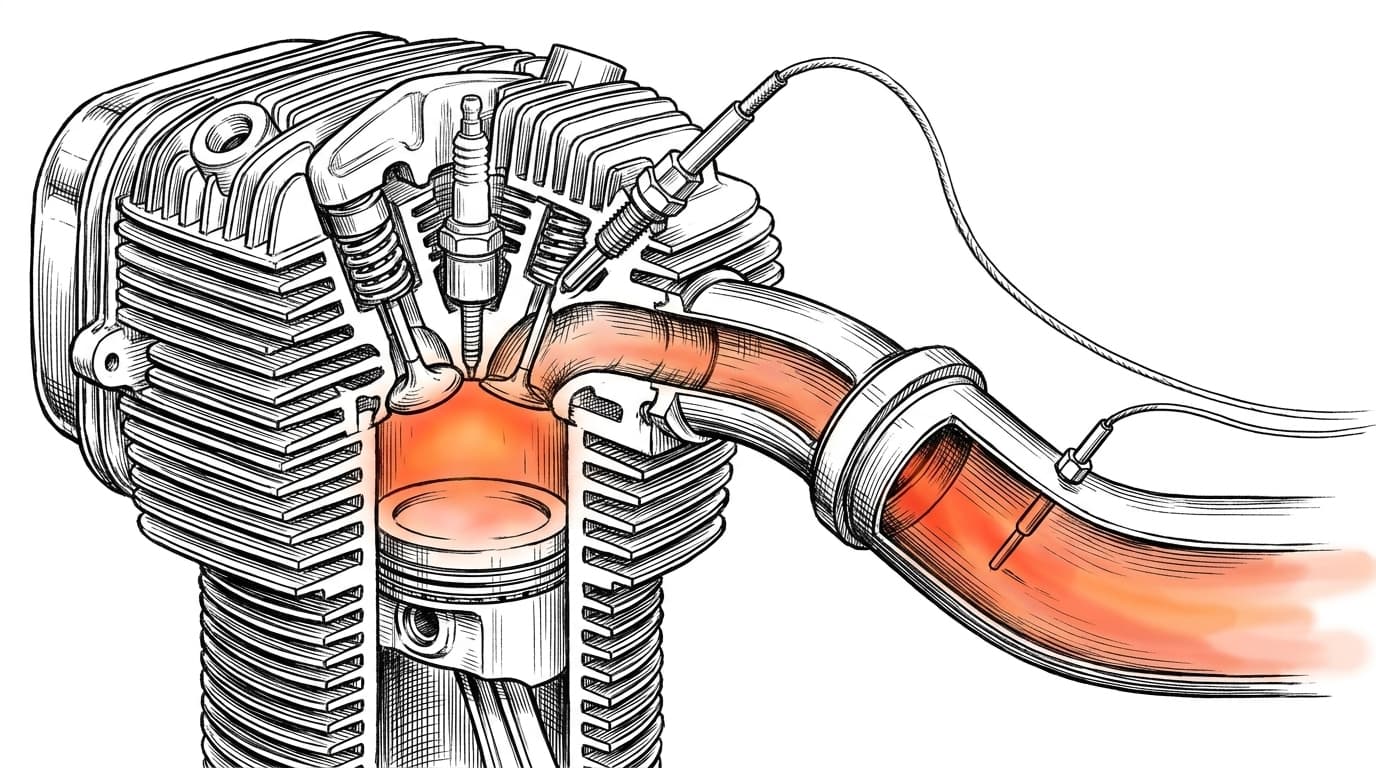
Put a temperature probe inside the combustion chamber and you would watch something dramatic. Cool mixture drawn in, compressed and warming, then the plug fires and the temperature goes nearly vertical, peaking around 4,000°F about 16 degrees after top dead center. Then the gas expands, the piston is driven down, and the temperature collapses as fast as it rose.
We have no probe in there. The EGT probe lives in the exhaust pipe, two to four inches downstream of the exhaust valve, and for most of the cycle that valve is shut. Intake stroke, compression, the entire power stroke: the probe sees nothing at all. Roughly two thirds of the time it is sitting in dead air, cooling off. Then the exhaust valve cracks open, a slug of gas somewhere near 2,000°F blows past it and drops fast as the pressure bleeds down, and the valve shuts again. Back to nothing.
So the probe takes short pulses of rapidly changing gas separated by long stretches of quiet. It has thermal mass. It cannot follow any of that, and it settles wherever the arithmetic of pulse and pause happens to leave it. That equilibrium is what your panel displays.
EGT is the temperature of the probe. It is not the temperature of anything you care about.
Which is why 1250 versus 1410 tells you very little. Move the probe an inch, use a different exhaust stack, and the number changes without a thing changing inside the cylinder.
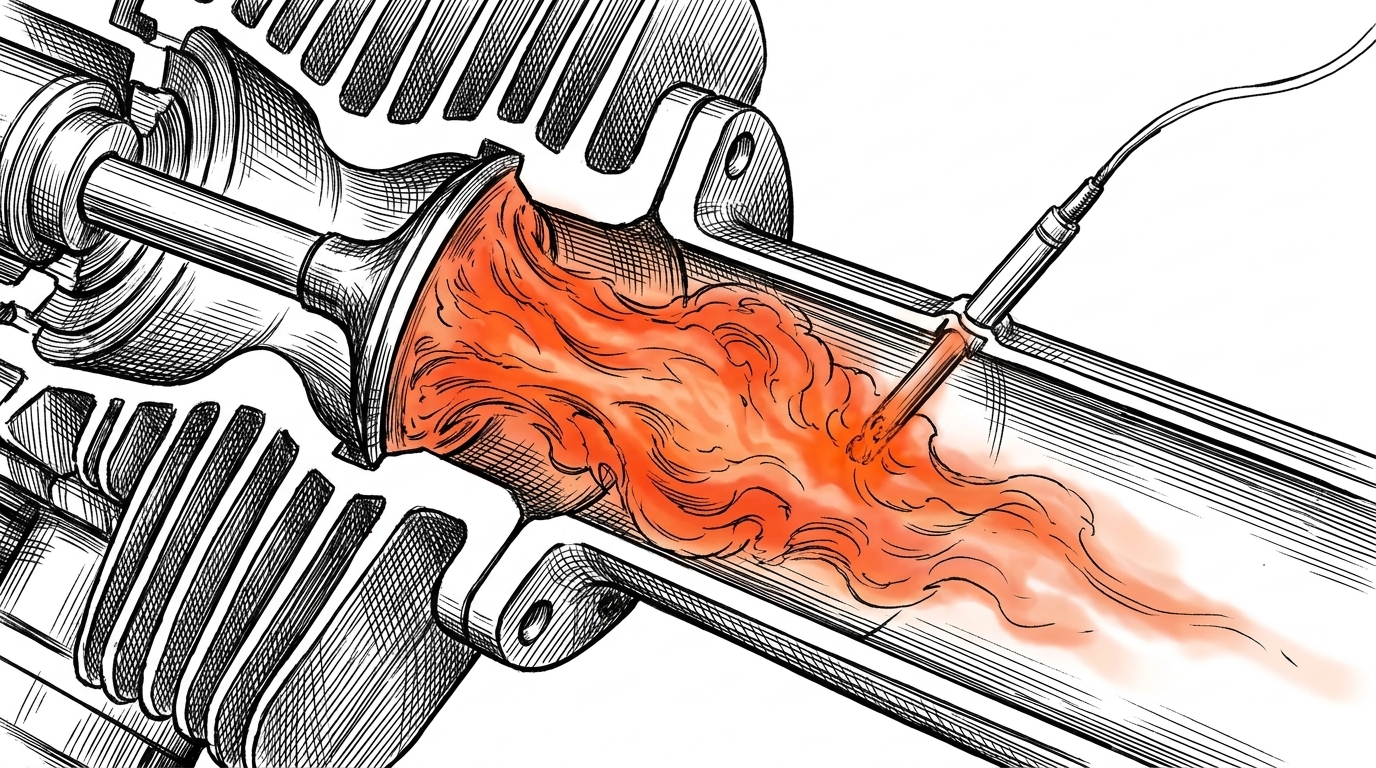
There is one honest exception. On a turbocharged engine the TIT probe sits far downstream, as close to the turbine inlet as it can get, where the pulses from all the cylinders have merged into steady flow. That probe really is reading gas temperature, and the 1650 or 1750°F limit that goes with it is a real limit protecting real turbine blades. It works because of where it sits. It is the same probe.
Both gauges are measuring waste
A piston aircraft engine, running perfectly, converts about a third of the energy in the fuel into work at the crankshaft. The other two thirds is thrown away, and it leaves by three doors.
About half of the fuel's energy goes straight out the exhaust pipe. Around 15% is dumped into the cylinder as heat and handed to the cooling air. A couple of percent heats the oil and goes out through the oil cooler. In a turbocharged engine you claw back a little of the exhaust portion by making it spin something useful on the way out, but the shape of it stands.
Every one of those doors has a gauge on it. EGT reads the energy going out the exhaust. CHT reads the energy going into the cylinder. Oil temperature reads the energy going into the oil. And the airspeed indicator, indirectly, reads the third that actually did some work, since speed goes as the square root of power. They are all waste gauges. The question is which waste tells you something worth acting on.
Why one of them matters and the other doesn't
The difference is when the heat arrives.
The heat CHT measures is deposited during combustion, at the moment the valves are shut, the pressure is at its peak, and the cylinder, piston, rod and crank are carrying everything they will ever carry. We have no cylinder pressure gauge in the panel. CHT is the closest thing to one we have.
The heat EGT measures is deposited during the exhaust stroke, after the engine has taken what it could and is pushing the leftovers out. The valve is open, the pressure has bled off, and nothing in the cylinder is under load worth mentioning. So CHT is a stress gauge and EGT is an inefficiency gauge. Holding CHT down protects the parts. Holding EGT down protects nothing, and if you look at what actually raises EGT, the logic runs backwards from what most people assume.
A spark plug that quits firing raises it, sharply. Kill a magneto during the runup and every EGT jumps 75 to 100 degrees. Is the engine working harder? It is working less. On one plug the flame front takes longer to cross the chamber, less of the burn happens where the crank can use it, and more of it is still going on when the exhaust valve opens. That is the RPM drop you just watched. Retarded ignition timing does the same thing: EGTs up, CHTs down, power down.
Almost everything that drives EGT up is something making the engine produce less power, not more.
Chase a low EGT number and you are chasing a healthy engine away from you.
The flat top that nobody needs
The second thing the absolute-number instruments taught people to want is a flat top: every EGT bar the same height. JPI even puts a number on it, the "diff" between the hottest and coldest cylinder, and owners email Busch constantly asking how to get theirs down from 80 degrees. They should not be trying.
Watch the EGT curves of a four-cylinder engine across a mixture sweep and the spread between them changes as you move the red knob. It is narrowest right around peak EGT and opens up as you go either rich or lean of that. Chase a flat top and you have chased yourself into the exact mixture region you want to avoid.
What matters is a different number entirely, and no instrument displays it: GAMI spread. In a perfectly balanced engine every cylinder would reach peak EGT at the same fuel flow. Real engines never do. The spread is the gap in gallons per hour between the fuel flow where the leanest cylinder peaks and where the richest one peaks, and finding it means flying a GAMI lean test, leaning slowly and writing down the fuel flow as each cylinder tips over.
An IO-550 out of a Bonanza makes the point. With the injectors it left the factory with, the first cylinder peaked at 14.6 gph and the last at 13.3, a spread of 1.3 gph. That engine would not run lean of peak worth anything and was burning perhaps an extra gallon an hour even rich of peak. Fit tuned injectors to the same engine and the spread comes down to 0.4 gph. The EGT diff on the tuned engine is still large, mind you. Cylinder 6 still runs visibly cooler than 4 and 5 on the bar graph. It does not matter. Every cylinder is now getting the same mixture, which is the only thing that was ever the goal.
Under a gallon an hour is acceptable. Under half a gallon is where you want to be. The number on the display labelled "diff" is not that number.
What EGT is actually good for
None of this makes EGT useless. It makes it a diagnostic instrument rather than an operating one, and at that job nothing else comes close.
All the EGTs up 75 to 100 degrees at once, CHTs normal or slightly down, is a magneto that has stopped working. Nothing a magneto does can affect a single cylinder, so when the whole bar graph rises together, that is where to look. Confirm it with an in-flight mag check.
One EGT up on its own is a spark plug that has stopped firing. It could be an ignition lead, but 98% of the time it is the plug. Switch to the magneto feeding that plug during the in-flight check and the engine will run rough while that bar collapses toward zero.
One EGT and its CHT moving together, in the same direction, is a partially blocked fuel injector. Rich of peak they both climb, lean of peak they both fall. If the nozzle blocks completely the cylinder simply quits, both readings fall off a cliff, and the engine gets rough. Full rich and a moment on the boost pump sometimes washes it clear if whatever is in there dissolves in fuel. If it stays rough, land.
One point of airmanship goes with the dead magneto. If you have shut one off in flight and the engine quits, do not just flip the key back to BOTH. With no ignition the engine keeps pumping fuel into a hot exhaust system. Throttle to idle first, then select the magneto, then feed the power back in, or you may find out what an exhaust stack sounds like when it lets go.
Four hundred degrees
Cylinder heads are aluminium alloy, and aluminium gets weak when it gets hot. By 400°F the head has given up roughly half its tensile strength, and above that the curve keeps falling away.
Continental puts its CHT redline at 460°F. Lycoming typically says 500. Busch's view of both numbers is blunt: they are emergency figures, not operating limits, and no engine should ever be anywhere near them.
My personal redline is 400. Between 380 and 400 I treat as a yellow arc. Above 400 I do something aggressive, because I am not going to let it stay there.
Peak cylinder pressure and CHT rise and fall with mixture in nearly the same shape, and both of them peak in the same place, about 40°F rich of peak EGT. That is the worst mixture in the entire range for the parts, and it is uncomfortably close to where a lot of pilots were taught to cruise.
The way out is either side, but the two sides are not the same distance away. Take the Continental chart for a normally aspirated IO-550 at 25 inches and 2500 RPM. Sitting at 40°F rich of peak you get 83% power and about 425°F on the heads. To bring that to 400 you go 10 degrees lean of peak, or 160 degrees rich of peak. Same result, wildly different journeys, because the CHT curve falls steeply on the lean side and only sags gently on the rich one. Either route costs you about 4% of power, which is 2% of airspeed, which on a 160 knot airplane is three knots.
Busch does not stop at 400. Getting to 380 means 35 degrees lean of peak, or a rich setting so far off the right side of the chart it is not plotted. Power drops to 77%, and there goes another three knots. That is the trade. Six knots for cylinders that go the distance. If you would rather have the six knots and buy jugs, that is a legitimate choice and it is yours to make; Busch has made the other one and says so plainly.
The other way out is simply less power. Pull below about 65% and the curves drop far enough that the mixture can go essentially anywhere without hurting anything. This is why the old advice about normally aspirated airplanes above 7,000 or 8,000 feet holds up. At full throttle up there you are already below 65%, and the red knob stops being dangerous.
Where the cooling air goes
CHT is a stress gauge with noise in it, because the same stress reads hotter or cooler depending on things that have nothing to do with the combustion event. Outside air temperature, measured against standard for your altitude rather than against how it feels; zero degrees at 17,000 feet is a hot day. Airspeed, which is why a slow climb runs hot. Altitude, which is really airspeed again, since cooling follows indicated airspeed and indicated falls away as you climb. Cooling system design, which is why an SR22 or a DA40 will sit 20 degrees cooler than a Bonanza or a 310 doing identical work. And cooling system condition, which is the one you can fix.
The system itself is simple. Ram air enters the top of the cowl and pressurises the upper half. Air leaves through a gap or through cowl flaps at the bottom, keeping the lower half at lower pressure. Metal baffles and flexible rubber seals form the wall between the two, so the only way from high pressure to low is down through the cooling fins.
Every leak in that wall is cooling you paid for and did not get. The inter-cylinder baffles are the ones that get missed, the small plates that sit between and beneath adjacent cylinders and stop air falling straight down the gaps instead of going around the fins. They are awkward to see and easy to leave misaligned. The check costs nothing: put a bright light under the engine, get up on a stool, and look down into the cowl from above. You should not see light anywhere through the gaps between cylinders. Where light gets through, air gets through, and air that gets through is not cooling anything.
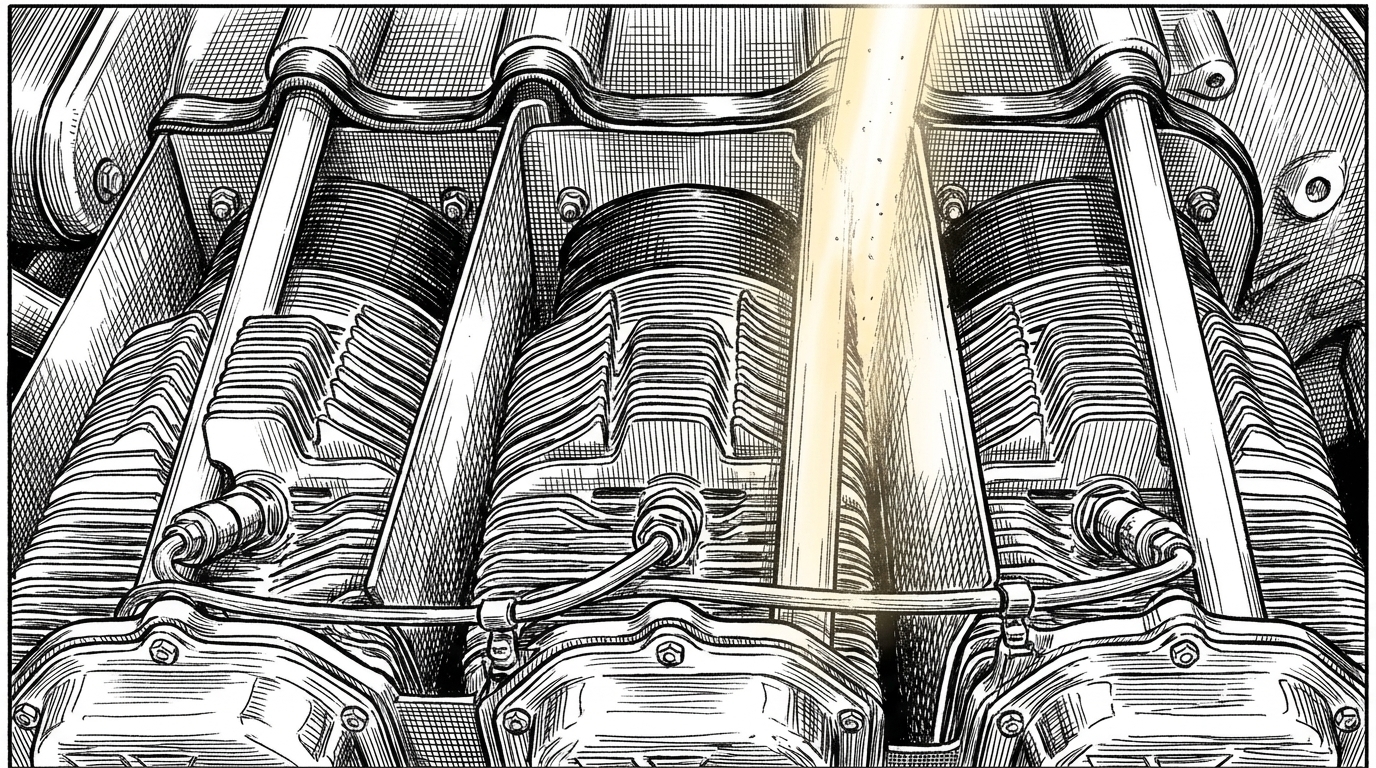
When CHT is high, Busch works three causes in order. Ignition timing first, because timing advanced even slightly runs the heads hot and the EGTs cool, and it is cheap to check. Then a rich and lean test to separate the other two. If the cylinder is hot at both extremes it is not getting enough air, and the baffles are lying to you. If it is hot rich and cools off lean, that cylinder is running lean, and leaning further has pushed it past peak.
The instrumentation to see any of this is not optional. The spread between the hottest and coldest cylinder on a normal engine runs 50 to 100°F, and the hottest one is very often not the cylinder the factory chose to put its probe on. A single-probe panel gives you a one in four or one in six chance of watching the cylinder that is in trouble. And the idea that a full engine monitor is a luxury for high performance airplanes has it exactly backwards.
Lose a cylinder in my twin and I still get where I am going. Lose one in a 172 and you are picking out a field.
Three and a half minutes
Combustion in a healthy cylinder is not an explosion. It is a controlled burn that takes about 6 milliseconds and 90 degrees of crankshaft rotation, lit 20 to 24 degrees before top dead center and reaching a peak of around 800 psi some 15 to 20 degrees after it.
Where that peak lands is the difference between an engine and an accident. With the piston at the top, the rod and crank are in line and there is nowhere for the pressure to go; it just heats the cylinder. Busch draws it as a bomb and a gun. Light the charge in a sealed tube and you get a bomb. Light it in a tube with a projectile free to move and you get a gun, which is the same energy doing something useful.
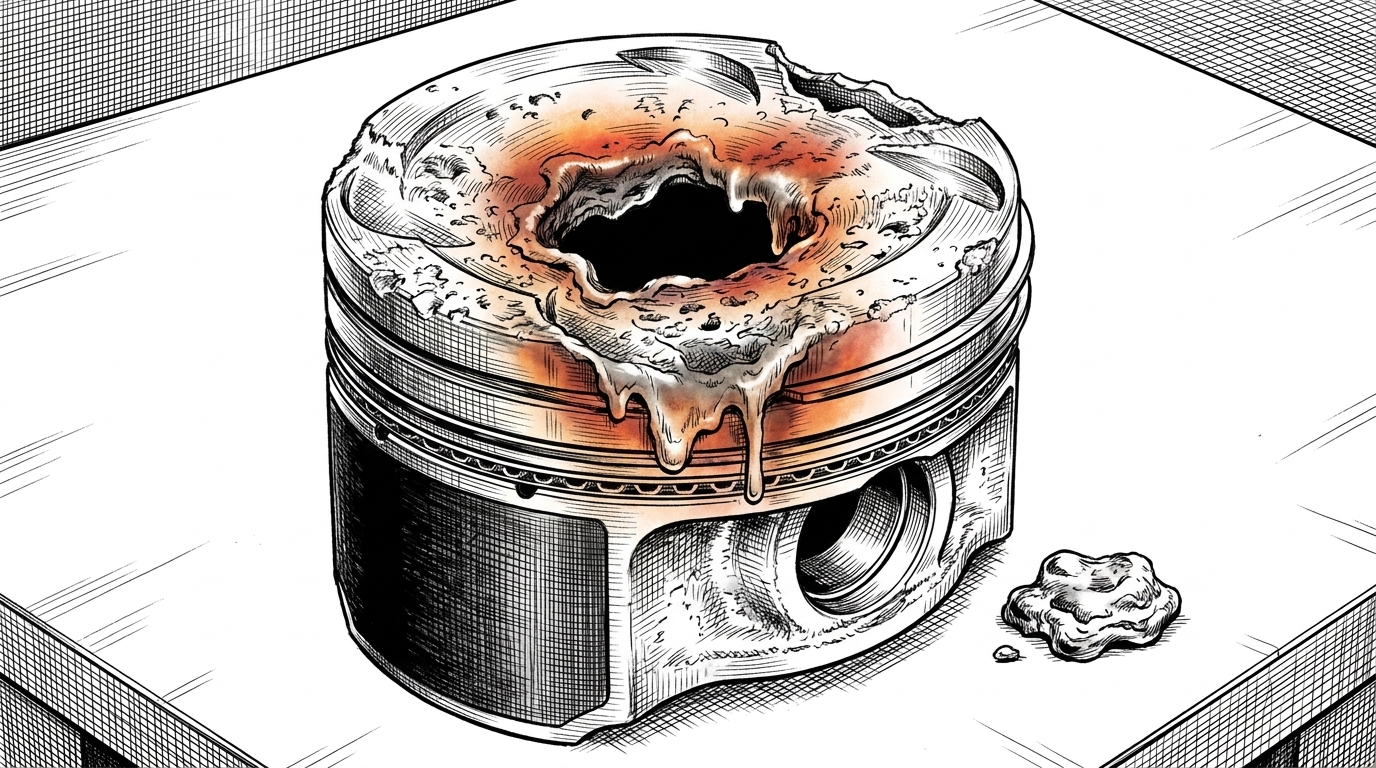
Detonation is what happens when that burn goes unstable, when it starts too early or runs too fast and pressures and temperatures climb past what the mixture will tolerate. Pockets of it go off on their own, out of sequence, and the pressure trace grows a jagged crown of shock waves where a smooth curve should be. It comes in degrees rather than as a switch, and light detonation does no harm at all. Heavy detonation cracks spark plug insulators, batters ring lands, pits the piston crown, and in the extreme melts metal. Busch has the photograph: a piston crown eaten away, the corners run like wax, the top ring land gone, and the rest of the engine downstream of all that debris.
Keep CHT below 400 and destructive detonation is essentially impossible.
Pre-ignition is a different animal and a much worse one. It happens when something in the chamber glows hot enough to light the mixture by itself, without waiting for the plug. An overheated spark plug tip will do it, so will carbon or lead deposits, and a spark plug insulator cracked by detonation is the classic route. A badly burned exhaust valve can do it too, though rarely. Now the burn starts early, peak pressure arrives before the piston reaches the top, and the cylinder is trying to drive the crankshaft backwards. Nothing survives that for more than a few seconds.
There is a data trace from a Cirrus SR20 that everyone flying behind an engine monitor should see once. Nearly new airplane, engine just out of break-in. The pilot applies takeoff power. Five CHTs climb the way they should and level around 360°F. Number one keeps going. At 500 the Avidyne stops recording, because 500 is as high as it counts; the cylinder probably reached 600 or 650. Then the trace falls, because by then there was no longer a combustion chamber to measure.
Ninety seconds from takeoff power to number one passing 400. Under two minutes from there to a hole melted clean through the piston. Three and a half minutes, start to finish.
The airplane had excellent instrumentation and it did exactly its job. It showed him one CHT climbing away from the others, and it presumably alarmed on the way past 400. Reducing power and turning back at any point in that first two minutes would have saved the engine. He filed a warranty claim instead. Continental declined it, as Busch had told him they would, because no engine manufacturer warrants detonation or pre-ignition damage.
The short version
Relative EGT is real information. Absolute EGT is not, and the instrument that displays it to one degree taught two generations of pilots to fixate on a number that describes a probe.
Leaning to hold a constant EGT in the climb is fine, because that is a relative target: whatever it read at 3,000 feet, hold it at 10,000, and it does not matter whether the reading is 1350 today and 1425 tomorrow. Leaning to hit 1400 because that is what somebody's Bonanza runs is not fine.
Minimise GAMI spread and ignore the diff. Some of the best balanced engines flying have 90 or 100 degrees between the hottest and coldest EGT, and it means nothing.
Use EGT to find out what is wrong. Use CHT to fly. Below 400 buys you cylinders that go the distance, and it costs a few knots you will not notice.
A CHT climbing fast through 400 gives you about a minute. Spend it flying the airplane, not wondering.
This article is based on the Savvy Aviation webinar All About EGT & CHT by Mike Busch.